30 years of impact: Drug Trends case studies over three decades
A series of case studies highlighting Drug Trends’ impact over the years.
Published on the 24 August 2026
2026 marks 30 years of the Drug Trends program, which monitors and identifies trends in drug use, markets and harms. Funded by the Australian Government, the program is conducted in partnership with the National Drug Research Institute, Burnet Institute, University of Tasmania and University of Queensland, and aims to provide timely, reliable information to guide policy and harm reduction efforts across Australia.
Origin story
The Illicit Drug Reporting System (IDRS) was the first project established under Drug Trends and was commissioned to address the limitations of earlier iterations of drug monitoring systems, which lacked a comprehensive, nationwide approach.
NDARC conducted a 12-month trial in Sydney piloting four key data collection methods. By 1997, the IDRS expanded to three states and by 2000, it was implemented across all Australian jurisdictions.
We really had to start from scratch – there was no research infrastructure in the addiction field.
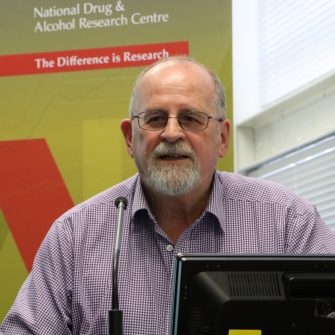
Professor Wayne Hall
Professor Wayne Hall, Director of NDARC (1994-2001)
The following case studies showcase examples of Drug Trends’ impact since it was established in 1996.
Drug Trends in the 2000s
Case study: Tracking the heroin drought
Drug Trends was the first to capture the “heroin shortage” of 2001, a major shift in Australia’s drug-use landscape. Drug Trends data showed prices went up, purity went down and the drug became harder to get, leading to less heroin use and fewer overdoses. But as heroin use dropped, methamphetamine and morphine use rose. This decline in availability eased around 2008.
Case study: Monitoring trends in temazepam capsule injection
Temazepam gel capsules – originally designed for oral use – were increasingly being injected, causing serious harm such as vein damage, abscesses and, in extreme cases, limb amputation. This resulted in restrictions on the prescribing of the 10mg capsules in 2002. However, Drug Trends data found that, while this reduced prescriptions, it did not curb injection practices or associated harms among people who inject drugs. In 2004, the capsules were taken off the market, and Drug Trends data showed this effectively ended their injection.
The impact of those little capsules on people's veins was devastating; and it was critical to systematically identify the size of the issue to get people to act.
Professor Raimondo Bruno
School of Psychological Sciences, University of Tasmania & NDARC, UNSW Sydney
Case study: World-first evidence into new psychoactive substances
First emerging on global drug markets in the early to mid-2000s, new psychoactive substances (NPS) sparked growing concern due to their rapid proliferation, unknown health risks and ability to evade existing drug laws. Drug Trends starting monitoring use of these substances in 2010, delivering world-first evidence on NPS use in Australia, offering critical insights into usage patterns and drivers.
Drug Trends in the 2010s
Case study: Amending restrictions on donating blood
Drug Trends findings helped support a submission to change eligibility criteria for donating blood.
In Australia, people with a history of injection drug use were previously restricted from donating blood indefinitely. Interviews with our sample of people who inject drugs in 2015/16 revealed that only 2-4% had ever donated blood after initiating injection drug use. Mathematical modelling estimated that reducing the eligibility restriction from indefinite to one or five years would result in a negligible increase in the risk of hepatitis C-infected blood collections. These findings supported a successful submission to change the eligibility criteria to five years, a policy that was implemented in September 2018, promoting more inclusive and evidence-based health policies.
IDRS plays a key role in providing data to support evidence-based guidance that enabled people who had injected drugs in the past to donate blood.
Professor Margaret Hellard AM
Burnet Institute
Case study: Action on ice
In 2015, data from Drug Trends played a key role in the National Ice Taskforce's Final Report, which identified critical gaps and made recommendations for a National Ice Action Strategy. Three years later, NDARC Director Professor Michael Farrell was the opening witness at the NSW Special Commission of Inquiry into ‘Ice’, where our data again served as a central source of evidence on increasing methamphetamine use and harms. The Inquiry resulted in 109 recommendations, and the NSW Government committed $500 million to improve treatment and support services.
Case study: Understanding the effects of OxyContin reformulation
On 1 April 2014, a tamper-resistant formulation of OxyContin® was introduced in Australia, replacing the original formulation. Designed to deter diversion, the new tablets were more difficult to crush, cut, chew or dissolve for injection.
Drug Trends’ annual surveys with people who inject drugs contributed to the systematic evaluation of this policy change. Findings showed that while overall population-level use of controlled-release oxycodone remained stable, there were clear reductions in both use and tampering – particularly injection – among populations of people who inject drugs.
Importantly, there was no evidence of displacement to other pharmaceutical or illicit opioids, or to other drug types. More recent data indicates that non-prescribed use of pharmaceutical opioids, including oxycodone, remains low.
Drug Trends in the 2020s
Case study: Building the evidence base for take-home naloxone
Naloxone is a life-saving medication that can help prevent opioid overdose. Image: Hanson - stock.adobe.com
Drug Trends research played a key role in shaping and evaluating Australia’s approach to take-home naloxone, the medication that reverses opioid overdose. Since 2013, our surveys have tracked uptake across states and territories, providing vital evidence to guide expansion. Findings from the evaluation of the 2019-2022 Take-home Naloxone Pilot showed increased access and use of naloxone, without any rise in risky opioid use. This evidence underpinned the Federal Government’s decision, backed by $19.6 million in funding – to make naloxone available nationwide and free of charge, saving lives and strengthening community overdose responses.
Opioid overdoses can be prevented, and take-home naloxone is a proven way to save lives.
Dr Rachel Sutherland
Deputy Program Lead for Drug Trends
Case study: A rise in drug checking
Drug Trends has provided critical evidence on how people who use drugs seek out information about the substances they consume. Before government-approved drug checking services existed in Australia, Drug Trends research documented how people relied on at-home reagent test kits, which were often inaccurate and used without expert guidance. These insights helped drive advocacy for official, evidence-based drug checking services. With fixed-site programs like CanTEST now established, our work continues to evaluate who uses these services and how they can best reduce harm. The findings are shaping the future of safe, informed and user-centred drug checking models across Australia.
Initiatives like drug checking help with market surveillance, provide essential harm reduction and connect people to health services. Through Drug Trends, we connect with people who use these services to understand what works.
Adjunct Associate Professor Caroline Salom
Institute for Social Science Research, The University of Queensland and NDARC, UNSW Sydney
Case study: Contributing evidence to the evaluation of ACT drug law reform
In October 2023, the Australian Capital Territory became the first Australian jurisdiction to decriminalise possession of small quantities of multiple illicit drugs, introducing a legislated pathway that allows police to divert individuals to a health education and information session or issue a $100 expiation notice. Drug Trends findings showed that awareness of the reform increased between 2023 and 2024 among two sentinel populations of people who regularly use illicit drugs in Canberra. However, understanding of the reform's details remained mixed. Many participants appeared to confuse decriminalisation with legalisation and held inaccurate perceptions about police and judicial responses. These findings were cited in the independent evaluation of the reform and contributed to a key recommendation that the ACT Government continue active and ongoing public information and education efforts
Case study: Informing responses to nitrous oxide harms
Drug Trends research provided some of the first national evidence on nitrous oxide use and related harms in Australia and identified increasing use of larger nitrous oxide canisters. Together, these findings helped build understanding of emerging risks and contributed key evidence to the Therapeutic Goods Administration, as well as regulatory considerations in Western Australia and New South Wales. This evidence informed measures aimed at reducing harms while maintaining proportionate access controls.
Want to know more?
Read this blog about how the program has evolved since it launched in 1996.