Up Front: News in brief
Mental Health Prize shines a spotlight on performers’ wellbeing.
Published on the 02 Aug 2017 by UNSW Media


Mental Health Prize shines a spotlight on performers’ wellbeing.
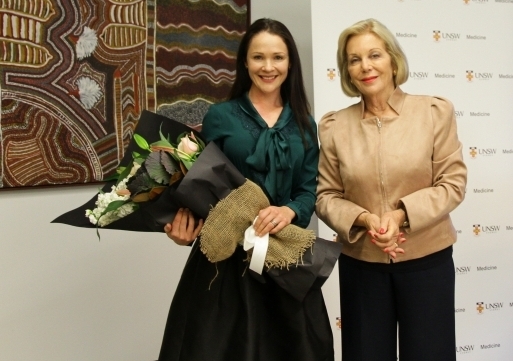
Award-winning Australian soprano and mental health advocate, Greta Bradman, has launched the 2017 Australian Mental Health Prize, seeking nominations to recognise Australians who have made outstanding contributions to either the promotion of mental health or the prevention and treatment of mental illness.
“I am delighted to join the Australian Mental Health Prize Advisory Group,” said Mrs Bradman. “I’ve experienced first-hand how debilitating mental illness can be and I understand that although it can take time to find a treatment plan to suit an individual, effective treatment is out there.
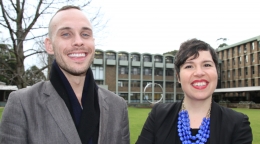
Two of Australia’s freshest new voices in science communication have been unearthed at UNSW, and are already brightening up the conversations in their areas of health research. Ursula Sansom-Daly and Denton Callander were selected from more than 100 talented entrants as winners of UNSW – ABC Radio National’s Top 5 Under 40 initiative. The quest aims to discover early-career researchers with a flair for communication, and to develop those instincts with a two-week media residency at the ABC, held in July.
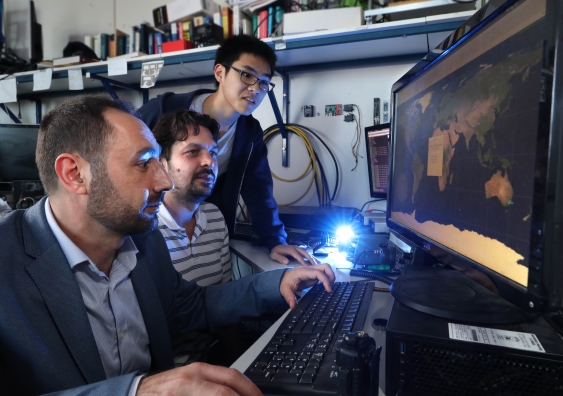
Two Australian satellites, feared lost after being deployed from the International Space Station (ISS), have been recovered by a team led by UNSW engineers after weeks of a fraught – and at times heart-stopping – recovery operation.
“It was like something out of Apollo 13,” said Elias Aboutanios (pictured above left), project leader for UNSW-EC0, the first Australian-built satellite in 15 years to go into space. “Our satellite was orbiting at 27,000kmh almost 400km above our heads. We couldn’t see it, couldn’t inspect it, and had almost no data to work with.”
Three Australian research satellites – two built at UNSW – blasted off on 19 April from Cape Canaveral as part of the international QB50 mission, a swarm of 36 small satellites (known as ‘cubesats’) designed to explore the little-understood region above Earth known as the thermosphere.
Within 30 minutes of deployment from the ISS, both UNSW-EC0 and INSPIRE-2 were meant to transmit a beacon. But no signal was detected from either by the ground teams at UNSW’s Australian Centre for Space Engineering Research (ACSER) or the Australian National University when the cubesats flew over Sydney, which they do twice a day.
Through a complex series of collaborations, including colleagues at the ANU and the University of Sydney, a Dutch sound technician and the International Space University in France, the team eventually solved the puzzle late in June.
“For more than three weeks, we were looking in the wrong part of the sky for our satellite – we couldn’t have known that,” said Aboutanios. “But the procedures we put in place, the scenarios we ran and the solutions we developed, they all paid off.” – Wilson da Silva
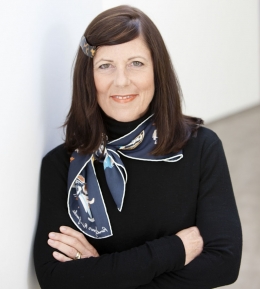
Dr Elizabeth Eastland.
• Dr Elizabeth Eastland (left) has been appointed to the position of Director Entrepreneurship. Over the last seven years, Dr Eastland has founded and led the University of Wollongong’s globally recognised innovation accelerator, iAccelerate. She has also been responsible for CSIRO’s innovation strategy and delivering Australia’s first national deep-tech accelerator.

Dr John Vallance.
• Former headmaster of Sydney Grammar School Dr John Vallance (right) will join UNSW as Honorary Professor for the Public Understanding of the Humanities. Dr Vallance will contribute to the celebration of the importance of the humanities as part of a rounded scientific, professional and technical education. He will also encourage collaboration between the tertiary and secondary education sectors to drive educational outcomes.
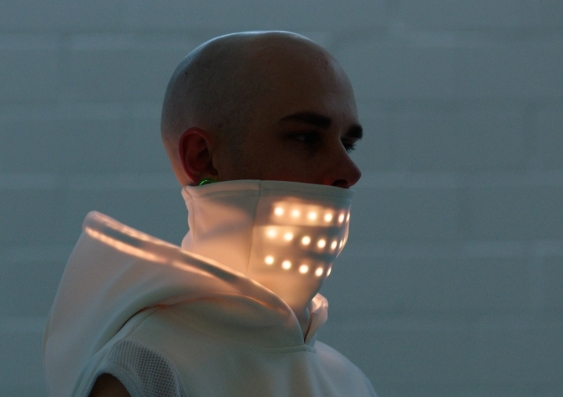
E-motion, a clothing range that allows men to communicate non-verbally.
Men’s clothing that lights up according to the wearer’s mood, a device that calms autistic toddlers and a virtual exercise coach, all created by UNSW graduates, have dominated the 2017 Young Designer of the Year Awards.
Lilian Hambling, a UNSW Art & Design graduate, won the coveted Young Designer of the Year Award for E-motion, a clothing range that allows men to communicate non-verbally. Sensors in the garments respond to the wearer’s pulse, muscle tension and proximity, converting the physical information into coloured light animations that emulate different emotions like a pounding heart, rush of adrenaline and the feeling of ‘butterflies’.
Hambling explains that by enabling “men to be more openly expressive, the stereotypical expectations of masculinity can change; instead of hiding them away, feelings – such as love, anger, fear and sadness – can be displayed as interactive gestures”.
Industrial Design graduate Era Camilet won the Design Innovation Award for HUG, a self-regulation and early warning system that lets parents of autistic children know when their child is about to have an aggressive outburst.
“HUG helps minimise injury and provides parents with a convenient, calming and socially acceptable way of tracking and managing their child’s behaviours,” says Camilet.
Jessi Wilkinson, also an Industrial Design graduate, won the Design Technology Award for Stride: Running Coach, a wearable virtual trainer for beginner to intermediate runners. Stride uses sensor technologies including heart-rate monitoring earbuds, a wearable sensor pod, and muscle-tech running tights to provide real-time audio feedback on running style.
– Fran Strachan