
Superhero drug takes out UNSW's 3 Minute Thesis
2025-09-03T13:19:00+10:00

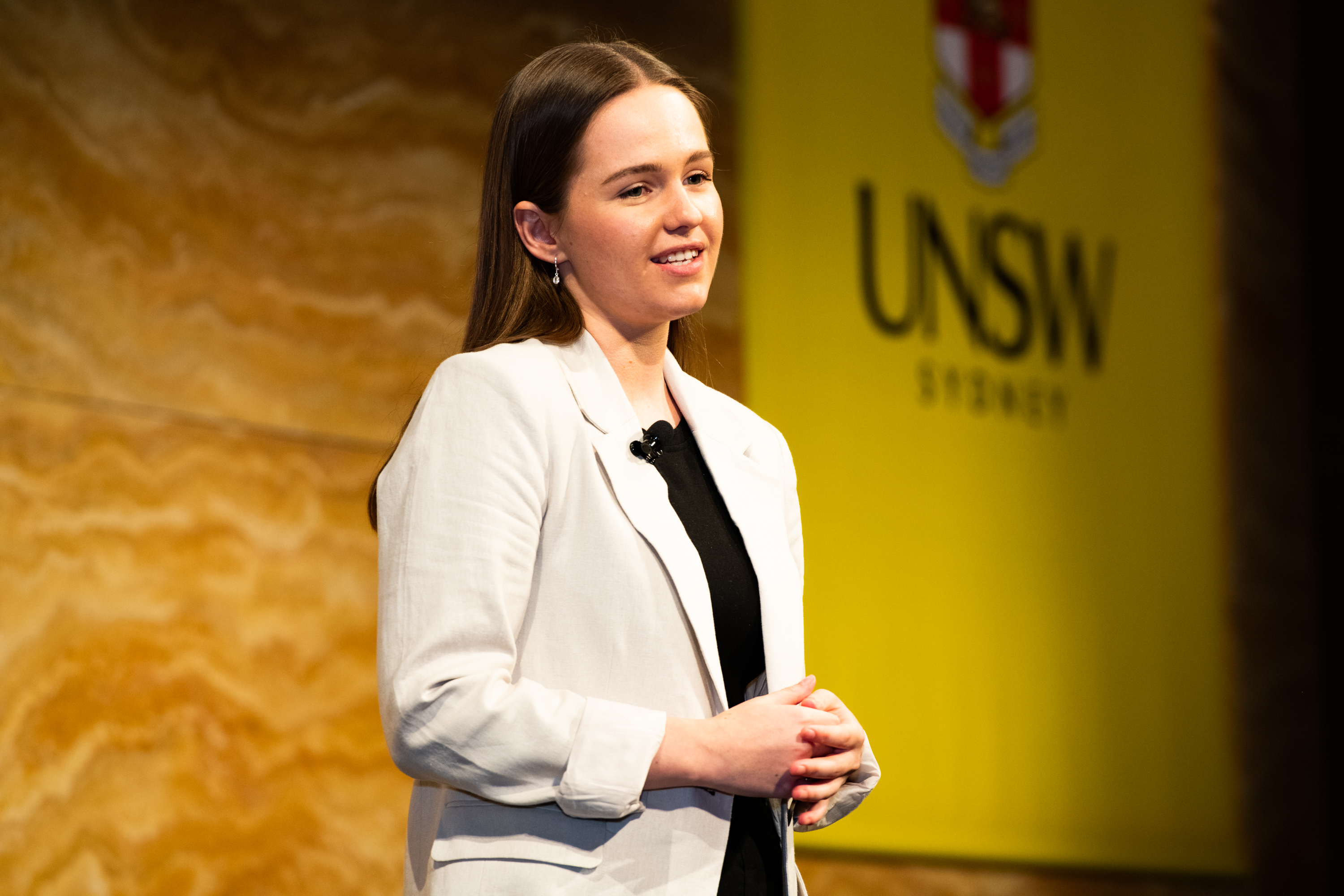
Professor Jonathan Morris, UNSW’s Pro Vice-Chancellor, Research Training and Dean of Graduate Research with Tiana Wang, winner of UNSW's 3MT in 2025.
Photo: Isabella Moore
PhD candidate Tiana Wang has won UNSW’s 3MT competition with her presentation on an RNA-based nasal spray, a potential ‘superhero drug’ against the rare HTLV-1 virus.
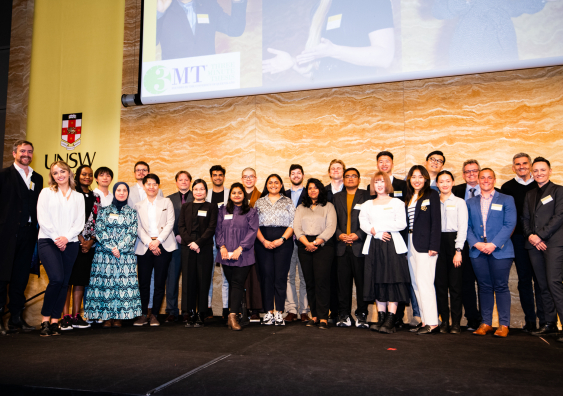
UNSW’s brightest PhD candidates took centre stage at the University’s 3 Minute Thesis (3MT) event on Tuesday evening.
Nineteen PhD candidates condensed their 100,000-word theses into three-minute presentations, delivered to a full house at Leighton Hall in the John Niland Scientia Building.
Presentations from across UNSW’s faculties covered a wide range of topics, from extracting oxygen from moon rocks to using smart driving data to create fairer car insurance premiums.
The winner of the $3000 top prize was Tiana Wang from The Kirby Institute and UNSW Medicine & Health, who shared her novel way of treating a common but potentially chronic virus. She will now represent UNSW at the Asia-Pacific 3MT Finals at the University of Queensland and the global International Universitas 21 competition.
“I loved the opportunity to present my research in front of my family, my partner, friends and neighbours, and I got a lot of ‘oh, so THAT’S what you do!’.
“From start to finish, the journey has reinforced the importance of science communication and how vital it is that everyone can understand the impact of our research as PhD students,” Tiana said.
“This is critical to inform the public about emerging technologies and progress, particularly in my area of RNA therapeutics.”

Tiana’s presentation highlighted her breakthrough approach to tackling Human T cell Leukaemia Virus Type 1 (HTLV-1), a little-known but devastating virus closely related to HIV. Affecting tens of millions globally and with rates as high as 40 per cent in some Central Australian communities, HTLV-1 can cause aggressive blood cancer, neurological damage, paralysis and death.
Tiana is developing the world’s first treatment for HTLV-1, using small interfering RNA (siRNA) technology to switch off the virus. Delivered via a simple nasal spray coated with lipid nanoparticles, the therapy offers a potential functional cure that is both accessible and non-invasive.
Her presentation used a superhero theme, portraying the virus HTLV-1 as the villain and her RNA-based therapy as the superhero coming to the rescue.
“When I signed up for the Medicine & Health faculty 3 Minute Thesis heats, I just had a title and a vague idea for a talk. I knew I wanted to do something with superheroes because I love Batman, but it took many iterations and presentations in front of my supervisor, Dr Chantelle Ahlenstiel, my research group, the Kirby and my friends and family before landing on the final script.”
Tiana said the next step was to make the therapy easy to use and scalable.
“Our goal is the eradication of HTLV-1, and we’re committed to ensuring that communities in Australia and around the world that need it most are the first to benefit.”
I loved the opportunity to present my research in front of my family, my partner, friends and neighbours, and I got a lot of ‘oh, so THAT’S what you do!’.

Professor Jonathan Morris, UNSW’s Pro Vice-Chancellor, Research Training and Dean of Graduate Research, said the 3MT was a valuable opportunity for PhD candidates to share the impact of their research.
“It’s a chance for our PhD researchers to shine and finally answer that age-old question their grandma always asks: ‘So, what are you doing in your PhD?’” Prof. Morris said.
“I’d like to congratulate everyone who presented. This year’s finalists impressed with the breadth and quality of their research. Every year I think it can’t get any better, and yet it does.
“Being able to communicate research effectively to a broad audience is essential for building engagement and securing funding, and this competition plays a vital role in helping our PhD candidates develop that skill.”
Runners up
Rachel Gray from the Faculty of Engineering took second place with her presentation on effective target detection in practical environments. Rachel presented on smarter radar systems that cut through sea clutter to improve real-time target detection, with applications in maritime search and rescue.
Third place went to Mohamed Hanafy Kotb Ibrahim from the UNSW Business School, who showed how driving data and AI can be used to make car insurance fairer. Mohammed proposed using telematics to base car insurance premiums on driving behaviour rather than fixed factors like age or gender.
The judges awarded two PhD candidates with Highly Commended: Fei Wu from the Faculty of Science and Natasha Naidu from the Faculty of Law & Justice.
Fei presented on why we eat comfort food and Natasha presented on the history and legacy of Indian indentured labour in the colonial sugar industry.

People’s Choice and The Founders Award
The People’s Choice award, decided by audience vote, went to Kaining Shen from the Faculty of Arts, Design & Architecture.
Kaining’s presentation explored the idea of ‘giving buildings a voice to reach net zero’ using digital twins – virtual replicas of buildings that update in real time. Connecting these models to AI large language models such as ChatGPT allows architects, engineers and facility managers to receive actionable insights to optimise energy use, reduce carbon emissions and support net-zero goals across a building’s life cycle.
The Founders Award was presented to Marcus Miljak from the Faculty of Science for his research on extracting oxygen from moon rocks using X-ray science.
Marcus’ work focuses on developing a portable X-ray scanner, refined through computer simulations, to identify rocks rich in oxygen. The technology could make it possible to generate oxygen on the Moon, reducing reliance on supplies from Earth and helping guide the placement of future outposts, observatories and infrastructure.
This year’s 3MT judges included Founder and CEO of Betashares Alex Vynokur, Communications Director at the ABC Freya Campbell, Director of Human Rights and Social Impact at KPMG Australia Dr Andy Symington, Deputy Dean of Graduate Research Professor Penny Martens and UNSW Vice-Chancellor and President, Professor Attila Brungs.
Media enquiries
For enquiries about this story and interview requests please contact Yolande Hutchinson:
Tel: 0420 845 023
Email: y.hutchinson@unsw.edu.au