
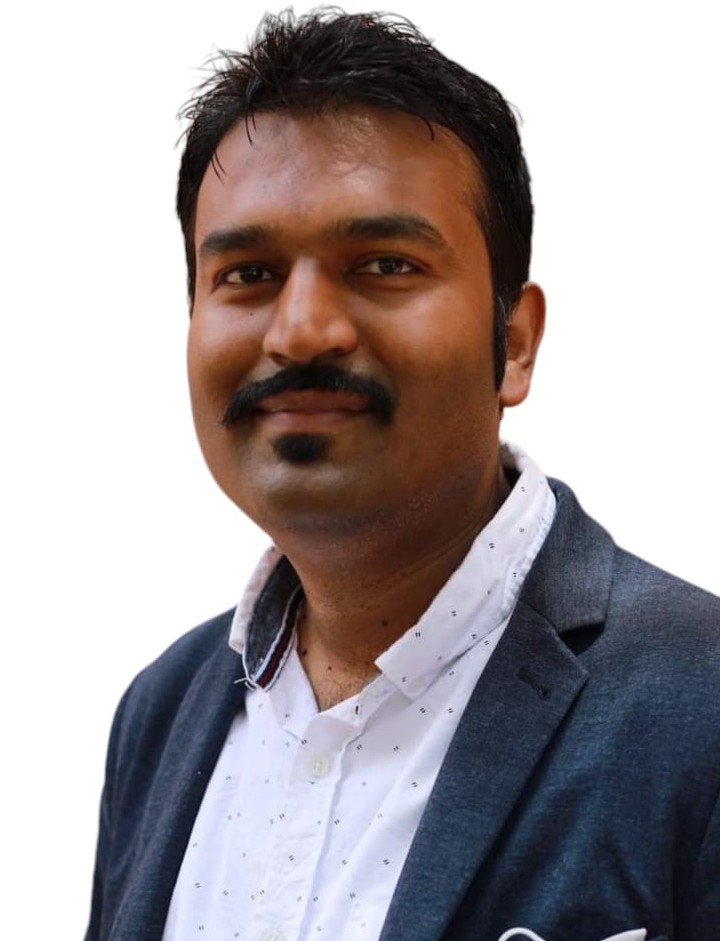
Associate Professor Rohitash Chandra
- PhD in Artificial Intelligence, Victoria University of Wellington (2012)
- MSc. in Artificial Intelligence, University of Fiji (2008)
- BSc. in Computer Science and Engineering Technology, University of the South Pacific (2006)
Dr Rohitash Chandra is an Associate Professor in Data Science at the UNSW School of Mathematics and Statistics. His research program focuses on advancing the methodologies and applications of artificial intelligence, with particular emphasis on Bayesian deep learning, large language models (LLMs), digital humanities, climate and environmental modelling, and mineral exploration. Dr Chandra’s work is distinguished by its interdisciplinary scope, integrating advances in machine learning with applications across science, the humanities, and broader societal challenges. He has contributed to the emerging area of applying artificial intelligence to the analysis of philosophical and religious texts, as well as cinema and media studies, with a focus on understanding representation, interpretation, narratives, and patterns of social behaviour and abuse. More recently, his research has expanded into large language models and AI ethics, investigating questions related to personality, consciousness, human values, and the design of responsible and human-centred AI systems.
Beyond science and engineering, Dr Chandra has strong interests in literature and the humanities and has edited and published poetry collections. He is also an advocate for human rights and diversity and served as a UNSW Cultural Diversity Champion (2021–2023). Dr Chandra has been the Data Theme Lead of the Australian Research Council (ARC ITTC) Training Centre for Data Analytics in Minerals and Resources (2020-2025). Dr Chandra has been one of the Chief Investigators of the NHMRC Medical Research Future Fund (2021-2022) project on the use of machine learning for COVID-19 drug repurposing.
Dr Chandra is on the Editorial Board for Geoscientific Model Development published by EGU. He has served as an Associate Editor for International Journal of Machine Learning and Cybernetics (2025), IEEE TNNLS, and Neurocomputing (2021-2022). Dr. Chandra is a Senior Member of IEEE and an Associate Fellow of the British Higher Education Academy (HEA). Dr Chandra is the founding director of the Transitional Artificial Intelligence Research Group (t-AI) at UNSW Sydney. Since 2020, Dr Chandra has been recognised consecutively in Stanford University’s list of the World’s Top 2% Scientists.
Prior to joining UNSW, Dr Chandra held a Chancellor's Research Fellowship at the University of Sydney (2017 - 2019). Prior to this, he has taken roles as a Research Fellow in Machine Learning at Rolls Royce @Corp Lab, Nanyang Technological University, Singapore; and Lecturer in Computing Science at the University of the South Pacific (2013- 2015). Originally from Nausori, Fiji, Dr Chandra has Girmit Indian heritage.
Note for HDR research aspirants: I receive a large number of Master of Research and PhD enquiries. If you do not receive a response to your email, it generally means that your application does not currently meet the minimum criteria for consideration for a UNSW PhD scholarship. UNSW PhD scholarships are highly competitive. Competitive applicants typically have an outstanding academic record (high GPA or equivalent) together with strong research experience, including evidence of first-authored publications in high-quality (Q1) journals or equivalent research outputs. The same requirements are for Masters by Research. Only applicants who meet these criteria are likely to be shortlisted for further consideration. If you are a self-sponsored applicant, you may still be eligible to apply for admission by meeting the University's entry requirements for the relevant HDR program. Please refer to the UNSW Higher Degree Research admissions page for details: https://www.unsw.edu.au/research/hdr/phd
- Publications
- Media
- Grants
- Awards
- Research Activities
- Engagement
- Teaching and Supervision
- S. Cripps, R. Chandra, et al., "ARC training centre in data analytics for resources and environments (ARC ITTC DARE)," 2020 - 2025: https://darecentre.org.au/ ($4,000,000 from ARC and $6,500,000 in-kind support from industry)
- S. Vasan and R. Chandra et al., "The sySTEMs initiative: systems biology-augmented, stem cell-derived, multi-tissue panel for rapid screening of approved drugs as potential COVID-19 treatments," NHMRC - Medical Research Future Fund, 2021- 2022 ($1,000,000)
- R. Chandra, Sydney Fellowship Awards, DVC Research, University of Sydney, 2017 -2019 (3 years Postdoctoral salary support plus $25,000 funding)
- D. Muller, R. Chandra, et al., Understanding the deep carbon cycle from icehouse to greenhouse climates, Sydney Research Excellence Initiative (SREI), DVC Research, University of Sydney, 2017 - 2018 ($300,000)
- UNSW Science Silverstar Award 2022, Faculty of Science, UNSW
- Sydney Fellowship Award, University of Sydney (2017-2019)
- Doctoral Completion Award, Victoria University of Wellington (2012)
Research Themes
I lead a transdisciplinary program of research encircling methodologies and applications of AI and data science. The methodologies include Bayesian deep learning, neuroevolution, ensemble machine learning, and data augmentation. The applications include climate extremes, mineral exploration, medical diagnosis, and digital humanities with focus on media and ethics for human-centric AI. Our key strength is in the development of novel deep-learning software frameworks with a focus on uncertainty quantification in decision-making. We have also pioneered the application of language models to the study of ancient religious and philosophical texts, opening new directions in digital humanities by enabling computational approaches to interpretation, comparison, and analysis of historically significant knowledge systems.
Machine learning and Bayesian deep learning
Our research develops machine learning methods that combine neuroevolution, Bayesian inference, transfer learning, and deep learning to build robust AI systems for prediction and decision-making. Early work introduced neuroevolutionary algorithms for dynamic time-series forecasting and modular pattern recognition (Chandra et al., 2017; Chandra et al., 2018), laying the foundations for modular deep learning architectures (Chandra and Cripps, 2018). We subsequently developed GAN-based data augmentation methods to improve learning from limited and imbalanced datasets (Sharma et al., 2022), later extending these approaches to extreme-event forecasting (Hua et al., 2025). We have developed models for data imputation taking uncertainity quantification into account (Ibenegbu et al, 2026) and currently focusing on spatiotemporal data imputation.
A major focus of our research is uncertainty-aware AI through Bayesian deep learning. We introduced scalable Bayesian neural networks using parallel tempering MCMC and parallel computing (Chandra et al., 2019), later extending these ideas to Bayesian graph neural networks, autoencoders, and transfer learning (Chandra et al., 2021; Chandra et al., 2022; Chandra and Kapoor, 2020). Currently, we are developing BayesClustering framework for uncertainty-aware clustering and representation learning. Future work will integrate Bayesian inference with multimodal learning, and foundation models.
Earth, Space and Climate Sciences
Our research applies machine learning, Bayesian inference, and remote sensing to Earth observation, environmental modelling, and planetary science. We demonstrated that satellite imagery combined with machine learning can automatically identify geological lineaments for mineral exploration (Farahbakhsh et al., 2020), and later extended these methods to lithological mapping in collaboration with the EarthByte Group (Shirmard et al., 2022). Current research integrates satellite imagery, geochemical observations, and spatial machine learning to support critical mineral exploration, alongside the development of open-source land-cover mapping tools for Fiji (Gurjar et al., 2026).
We have also developed machine learning methods for forecasting climate extremes, including tropical cyclone intensity and trajectory (Chandra and Dayal, 2015; Deo and Chandra, 2019; Sutar and Chandra, 2025), flood prediction and streamflow modelling (Kapoor and Chandra, 2026; Chandra et al. 2025). Complementing these predictive models, we developed the Bayeslands and Bayesreef frameworks for Bayesian inference in geoscientific models, enabling uncertainty quantification in landscape and reef evolution (Chandra et al., 2019; Chandra et al., 2020).
More recently, we have extended these approaches to planetary exploration, developing deep learning methods for crater detection on the Moon and Mars (Ma et al., 2026) and unsupervised learning approaches for mineral mapping from Martian orbital imagery (Lovelock and Chandra, 2025). Current research investigates multimodal large language models that combine orbital imagery, terrain models, geological maps, and scientific literature to analyse Martian dust storms and assess candidate landing sites. Our long-term goal is to build trustworthy AI systems that support autonomous scientific discovery and future robotic and human missions to the Moon and Mars.
Digital Humanities and LLMs
Our research explores how foundation models can advance the study of language, culture, philosophy, and the humanities. We developed evaluation frameworks for machine translation in Sanskrit, Mandarin, and several Indian languages, providing systematic comparisons between human translators, Google Translate, and large language models (Shukla et al., 2023; Wang et al., 2025; Chandra et al., 2025).
We have also applied language models to analyse cinema and music, including longitudinal studies of violence in Hollywood movies (Chandra and Ren, 2025). We have laid the foundations of AI for religion including computational analysis of the Bhagavad Gita and the Upanishads (Chandra and Kulkarni, 2022; Chandra and Ranjan, 2022), and metaphor detection across religious texts (Chandra et al., 2024). Current research focuses video hallucination diagnostics, retrieval-augmented generation (RAG), and Vedanta-RAG for Hindu philosophy.
A growing thread of this work is the ethical foundations and responsible design of LLMs, with particular attention to personality, consciousness, and fairness. We are currrently drawing on Hindu philosophical schools such as Ahimsa and Nyaya for ethical decision-making in agentic AI. Future projects will extend this to the simulation of AI-assisted personalities across different problem-solving contexts, laying groundwork for novel applications in cyberspace and games.
My Research Supervision
Research Supervision
Current PhD Students
-
Sangdeok Lee, “LLM Ethics and Human-Centred AI,” PhD, School of Mathematics and Statistics, UNSW Sydney, June 2026–present. Principal Supervisor (Co-supervisors: Dr Eka Shinjikashvili and Dr John Hawkins, External).
-
Amuche Igenegbu, “Uncertainty quantification in data imputation problems with Bayesian machine learning,” PhD, School of Mathematics and Statistics, UNSW Sydney, February 2024–present. Principal Supervisor (Co-supervisor: A/Prof. Pierre Lafaye de Micheaux).
-
Guoxiang (Ricky) Ren, “Natural Language Processing for Cinema Studies,” PhD, School of Mathematics and Statistics, UNSW Sydney, September 2024–present. Principal Supervisor (Co-supervisor: Dr Eka Shinjikashvili).
PhD Completions
-
Arpit Kapoor, “Bayesian Deep Learning for Climate Extremes and Hydrological Models,” PhD, School of Mathematics and Statistics, UNSW Sydney, April 2026. Principal Supervisor (Co-supervisor: Dr Sahani Pathiraja; External Supervisor: Prof. Lucy Marshall). Secured Postdoc at USyd
-
Mahsa Tavakoli, “Synergy of Language Models and Time Series Models for Credit Rating Forecasting,” PhD, Western University, Canada, February 2026. External Supervisor (Principal Supervisor: A/Prof. Cristian Roman).
-
Saman Forouzandeh, “Recommender Systems Using Graph-Based Deep Learning,” PhD, School of Mathematics and Statistics, UNSW Sydney, April 2025. Joint Principal Supervisor (Co-supervisor: Dr Pavel Krivitsky). Secured Postdoc at RMIT
-
Ratneel Deo, “Deep Learning for Understanding Geocoastal and Reef Development,” PhD, University of Sydney, April 2025. External Supervisor (Supervisors: Prof. Jody Webster and Dr Tristan Salles). Secured Postdoc at USyd
-
Dr Nhat Minh Megan Nguyen, “Bayesian Inference for Complex Models,” PhD, University of Sydney, September 2024. External Supervisor (Supervisors: A/Prof. Minh-Ngoc Tran and Dr Tongliang Liu).
-
Dr Amit Kumar, “A Multimodal Approach for Clustering Risk Levels in Pulmonary Fibrosis Patients Using Respiratory and EMG Data,” PhD, Beijing Institute of Technology, April 2023. External Supervisor.
-
Dr Ehsan Farahbakhsh, “Developing a Novel Method for Three-Dimensional Modelling of Ore Deposits by Integrating Data Layers,” PhD, Amirkabir University of Technology, Tehran, December 2020. External Supervisor. Secured Postdoc at USyd
Honours Thesis Completions
-
Jack Choi, “Transformation of Abusive Comments Using LLMs,” Honours in Quantitative Data Science, UNSW Sydney, 2025. Principal Supervisor.
-
Yathin Suresh, “Analysis of Billboard Songs Using Natural Language Processing,” Honours in Computational Data Science, UNSW Sydney, 2025. Principal Supervisor.
-
Raine Bianchini, “Language Models for Audio Transcription Analysis in Movies,” Honours in Quantitative Data Science, UNSW Sydney, August 2025. Principal Supervisor.
-
Omkar Kulkarni, “Financial Fraud Detection in Cryptocurrency Using Graph-Based Deep Learning,” Honours Thesis in Economics, BITS Pilani–Goa, India, July 2025. Principal Supervisor.
-
Xuechun Wang, “Evaluation of Google Translate for Selected Chinese Texts: Sentiment and Semantic Analysis,” Honours in Quantitative Data Science, UNSW Sydney, August 2024. Principal Supervisor (Co-supervisor: Dr Rodney Beard).
-
Shuhao Huang, “Explainable Artificial Intelligence for Drought Prediction in Australia,” Honours in Computer Engineering, UNSW Sydney, May 2024. Principal Supervisor.
-
Albert Demskoy, “Bayesian Models for High-Category Cyclone Forecasting Using Sea Surface Temperature: Four Decades Ahead,” Honours in Data Science, UNSW Sydney, December 2023. Principal Supervisor.
-
Rahul Ahluwalia, “Data Augmentation for Extreme-Value Forecasting Using Deep Learning,” Honours in Data Science, UNSW Sydney, December 2023. Principal Supervisor.
-
Jim Ng, “Conditional Ensemble Deep Learning for Modelling Australian Climate Extremes: Streamflow and Floods,” Honours Thesis, UNSW Sydney, December 2022. Primary Supervisor (Co-supervisor: A/Prof. Willem Verwoort).
-
Eric Chen, “Deep Learning for Modelling Historical Groundwater Levels Using Streamflow and Precipitation Data,” Honours Thesis, UNSW Sydney, December 2022. Primary Supervisor (Co-supervisor: A/Prof. Martin Andersen).
-
Royce Chen, “Pruning Bayesian Neural Networks with MCMC,” Honours Thesis, UNSW Sydney, December 2022. Joint Supervisor (Co-supervisor: Dr Sahani Pathiraja).
-
Sean Luo, “Evaluation of GANs Using Dimensionality Reduction,” Honours in Data Science, UNSW Sydney, May 2022. Joint Supervisor (Co-supervisor: Dr Sahani Pathiraja).
-
George Maksour, “Evaluation of Deep Reinforcement Learning Models for Horse-Race Betting,” Honours in Data Science, UNSW Sydney, May 2022. Joint Supervisor (Co-supervisor: Dr Sahani Pathiraja).
-
George Bai, “Bayesian Neural Ensemble Learning with Parallel Tempered Langevin MCMC,” Honours Thesis, UNSW Sydney, December 2021. Principal Supervisor.
-
Jodie Pall, “Bayesreef: Reef Evolution Using Bayesian Inference,” Honours Thesis, School of Geosciences, University of Sydney, December 2018. Secondary Supervisor (Supervisors: Prof. Jody Webster and Dr Tristan Salles). Recipient of the University Medal.
Master’s by Research Completions
-
Honghui Wang, “Deep Learning for Instant Pedestrian Path Prediction,” Master by Research, UNSW Sydney, 2024. Principal Supervisor (Co-supervisors: A/Prof. Gustavo Batista and Dr William Zhi).
-
Chaarvi Bansal, “Machine Learning Framework for COVID-19 Drug Repurposing,” Master of Science (Biological Sciences), BITS Pilani & UNSW Sydney, 2022. Principal Supervisor (Co-supervisor: Prof. P. R. Deepa).
-
Julian Rodriguez, “Machine Learning for Spatiotemporal Mineral Prospecting Using Plate Tectonic Models,” MPhil, University of Sydney, 2020. External Supervisor (Principal Supervisor: Prof. Dietmar Müller).
-
Ratneel Deo, “Neural Network Methodologies for Cyclone Wind Intensity and Path Prediction,” Master of Science in Computing Science, University of the South Pacific, Fiji, December 2017. Primary Supervisor. Nominated for Best Thesis (Gold Medal).
-
Ravneil Nand, “Competitive Island Cooperative Neuro-Evolution for Time Series Prediction,” Master of Science in Computing Science, University of the South Pacific, Fiji, January 2016. Primary Supervisor.
-
Kavitesh Bali, “Competitive Island Cooperative Coevolution for Real-Parameter Global Optimisation,” Master of Science in Computing Science, University of the South Pacific, Fiji, September 2015. Primary Supervisor. Awarded the Gold Medal for Best MSc Thesis; recipient of a PhD Scholarship at Nanyang Technological University (2016).
-
Shonal Chaudhary, “Mobile-Based Face Recognition for Visually Impaired Persons,” Master of Science in Computing Science, University of the South Pacific, Fiji, August 2015. Primary Supervisor.
-
Shamina Hussein, “Multi-Step-Ahead Prediction Using Recurrent Neural Networks,” Master of Science in Computing Science, University of the South Pacific, Fiji, 2015. Primary Supervisor.
-
Swaran Ravindra, “Health Information Systems in Fijian Hospitals,” Master of Science in Information Systems (Minor Thesis), University of the South Pacific, Fiji, 2015. Primary Supervisor.
-
Shelvin Chand, “Multi-Objective Cooperative Neuro-Evolution for Chaotic Time Series Prediction,” Master of Science in Computing Science, University of the South Pacific, Fiji, August 2014. Primary Supervisor. Recipient of a PhD Scholarship at UNSW Australia (2015).
Master’s Coursework Research Projects
-
Thomas Duffy, “Analysis of Antisemitic Trends in Media Using LLMs,” Master of Statistics, UNSW Sydney, December 2025. Principal Supervisor.
-
Cheng Wang, “SOM-Based Mineral Exploration,” Master of Information Technology, UNSW Sydney, December 2025. Principal Supervisor.
-
Yue Zhang, “Evaluation of LLM-Based Translation from Mandarin to English,” Master of Data Science and Decisions, UNSW Sydney, December 2025. Principal Supervisor.
-
Zhenyu Zhu, “Sanskrit Optical Character Recognition Using Advanced Deep Learning Models,” Master of Data Science and Decisions, UNSW Sydney, August 2025. Principal Supervisor.
-
Yizhen Fan, “Electric Load Forecasting Using Deep Learning Models,” Master of Financial Mathematics, UNSW Sydney, August 2025. Principal Supervisor.
-
Junru Hua, “Extreme-Value Forecasting with Data Augmentation and Deep Learning,” Master of Data Science and Decisions, UNSW Sydney, August 2025. Principal Supervisor.
-
Ziyu Lei, “Political Leaning Analysis Using Large Language Models,” Master of Statistics, UNSW Sydney, May 2025. Principal Supervisor.
-
Tanay Panat, “Global Ease of Living Index Using Data Imputation and Dimensionality Reduction,” Master of Data Science, UNSW Sydney, December 2024. Principal Supervisor.
-
Chen Wang, “Sinophobia During COVID-19: A Twitter Analysis,” Master of Data Science, UNSW Sydney, August 2024. Principal Supervisor.
-
Yeshwanth Rayavarapu, “Comparison of GPT and Google Translate for Selected Indian Languages,” Master of Data Science, UNSW Sydney, May 2024. Principal Supervisor.
-
Ruoni Wen, “Remote Sensing and Deep Learning for Land-Cover Classification in Fiji,” Master of Statistics, UNSW Sydney, August 2023. Principal Supervisor (Co-supervisor: Dr Ehsan Farahbakhsh).
-
Alex Bradford, “Variational Deep Learning for Stock Price Prediction,” Master of Statistics, UNSW Sydney, August 2023. Principal Supervisor.
-
Mukuan Hsu, “Topic Modelling for COVID-19 Vaccine-Related Tweets,” Master of Computing Science, UNSW Sydney, August 2023. Principal Supervisor.
-
Hamish Haggerty, “Self-Supervised Deep Learning,” Master of Statistics, UNSW Sydney, May 2023. Principal Supervisor.
-
Tianyi Wang, “Revisiting the World Economic Outlook Post-COVID-19 Using Deep Learning,” Master of Statistics, UNSW Sydney, December 2022. Primary Supervisor.
-
Yuhao Ke, “Machine Learning for NBA Analytics,” Master of Statistics, UNSW Sydney, December 2022. Primary Supervisor.
-
Mingyue Kang, “COVID-19 Mutation Over Time,” Master of Statistics, UNSW Sydney, May 2022. Principal Supervisor (in collaboration with Prof. Seshadri Vasan, CSIRO).
-
Jiaxin Cathy Yu, “COVID-19 Diagnosis Using Big Data,” Master of Statistics, UNSW Sydney, May 2022. Principal Supervisor (in collaboration with Prof. Seshadri Vasan, CSIRO).
-
Kelin Liu, “Clustering Methods for Vessel Tracking Using Satellite Data,” Master of Statistics, UNSW Sydney, May 2022. Principal Supervisor (in collaboration with Dr Rodney Beard, FFA).
-
Zhilin Wei, “Computer Vision for Aerial Tracking of Coastal Plastic Waste,” Master of Statistics, UNSW Sydney, December 2021. Principal Supervisor.
-
Dizhou Feng, “Graph Neural Networks for Spatiotemporal Forecasting,” Master of Statistics, UNSW Sydney, December 2021. Principal Supervisor.
-
Yueyang Zhang, “Gradient-Boosting LSTM for Reducing Model Uncertainty,” Master of Statistics, UNSW Sydney, December 2021. Principal Supervisor.
-
Shaodong Lin, “World Economic Outlook Post-COVID-19 Using Deep Learning,” Master of Statistics, UNSW Sydney, December 2021. Principal Supervisor.
-
Yixuan He, “Bayesian Neural Learning for Financial Prediction,” Master of Financial Mathematics, UNSW Sydney, August 2020. Principal Supervisor.
Research Staff Supervision
-
Dr Shuang Liu, Research Fellow, School of Mathematics and Statistics and UNSW Water Research Laboratory, UNSW Sydney, 2024–2025. Joint supervision with A/Prof. Fiona Johnson. Research area: Machine Learning and Remote Sensing for Environmental Assessment.
-
Danial Azam, Research Engineer, ARC Basin Genesis Hub, University of Sydney, January 2018 – December 2020. Co-supervision with Prof. Dietmar Müller.
Research Interns and Student Collaborators
2026: Simon Yaqing Zhang, Haoyan Chen, Jiacheng Chen, Yuting Wu, Ruonan Wang, Jiaming Yang, Maanaav Anil Motiramani, Jiaqian Li, Jun Kim, Kaif Hussian, Prachi Sharma, Devika Hareesh, Jayesh Sonawane, Jessie Guo, Arun Kumar Selvaraj, Takshil Aggarwal
2025: Divisha Naharas, Fangli Cheng, Aditya Pramar, Jiaming Yang, Liang Long, Sungkyun Yoo, Viswas Dubey, Sai Rugved, Arun Kumar Selvaraj
2024: Aryan Chaudhary, Vamshika Sutar, Tanuj Chaudhary, Kartik Disawal, Omkar Kulkarni
2023: Mahek Vora, Naman Jain, Akshat Shukla, Azal Khan, Omkar Chaudhari, Siddharth Khedkar, Tvisha Malik
2022: Azal Khan, Saharsh Bharve, Shirin Jain, Snigdha Jain, Janhavi Lande, Chaarvi Bansal, Pranjal Singh, Gunjan Dhanuka, Suryansh Shrivastava, Pranshu Kandoi, Pandaya Pranshu, Dhiraj Pimparkar, Dakshi Goel
2021: Sweta Rathi, Mukul Ranjan, Amandeep Singh, Ritam Manabendra, Anshul Negi, Rishabh Sharma, Sahil Bohra, Ayush Bhagat, Venkatesh Kulkarni, Sandeep Nagar
2020: Ritij Saini, Aswin Krishna, Prabhat Singh, Jiaxin Yu, Animesh Renanse, Shaurya Goyal, Yash Sharma, Ashish Gupta, Manavendrasinh Maharana, Animesh Tiwari, Eshwar Nukala, Arya Arya, Mahir Jain, Ayush Bhagat, Ayush Jain, Divyanshu Singh, Kousik Rajesh
2019: Aakarsh Yadav, Ashray Aman, Rishab Gupta
2018: Konark Jain, Arpit Kapoor, Ratneel Deo, Wil Grebner
More details:
https://transitional-ai.github.io/team/
My Teaching
Master of Data Science:
- ZZSC5836 - Data Mining and Machine Learning (Online), https://studyonline.unsw.edu.au/online-programs/master-data-science
- MATH5836 - Data Mining, Trimester 3: https://www.maths.unsw.edu.au/courses/math5836-data-mining Github repo: https://github.com/rohitash-chandra/dataminingMATH5836
Programming Bootcamp:
- Resources - code and exercises: https://github.com/rohitash-chandra/python-bootcamp
- Youtube Videos available