Global ambitions: two UNSW alumni awarded John Monash Scholarships
2025-11-03T12:00:00+11:00

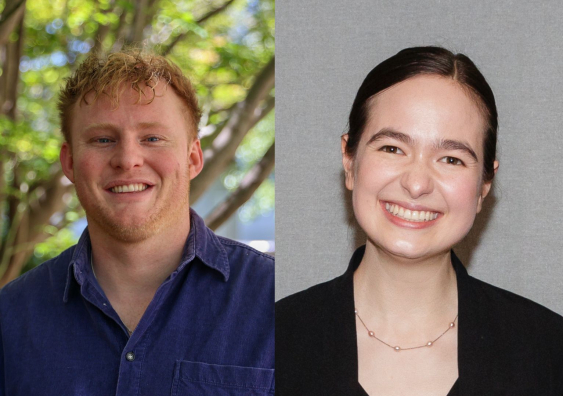
UNSW alumni Thomas Schmaltz and Nick Clarke are among 18 exceptional Australians to receive 2026 John Monash Scholarships.
Photos: Supplied

Earth scientist Thomas Schmaltz and Australian Defence Force soldier Nick Clarke will pursue postgraduate studies in the US and UK as 2026 John Monash Scholars.
UNSW alumni Thomas Schmaltz and Nick Clarke have been named among 18 outstanding Australians to receive 2026 John Monash Scholarships, recognising their leadership, academic excellence and commitment to public service.
Mr Schmaltz has been awarded the Zelman Cowen John Monash Scholarship. He intends to undertake a Doctor of Philosophy in Geophysics at the University of California, San Diego. His studies will advance satellite research and Antarctic expeditions, with the goal of supporting Australia’s global leadership in climate resilience.
Dean of Science Professor Sven Rogge congratulated Mr Schmaltz on the prestigious recognition.
“Tom’s achievement is a testament to his dedication to advancing our understanding of climate science,” Prof. Rogge said. “His research into ice sheet processes and sea-level rise will make a valuable contribution to global efforts in climate resilience, and we’re incredibly proud to see him represent UNSW on the world stage.”
Mr Clarke has been awarded the Rio Tinto John Monash Scholarship, and will complete a Masters in Defence and Security Leadership and Management at Cranfield University in the UK. His research will focus on offering better support for serving and ex-serving soldiers to help reduce veteran suicide rates.
UNSW Canberra Dean and Rector, Professor Emma Sparks, said Mr Clarke exemplifies the values of leadership, service and dedication that are central to the University and the Australian Defence Force.
“Nick’s commitment to improving support for serving and ex-serving personnel will have a lasting impact on the wellbeing of Australia’s defence community, and we’re proud to see him continue this important work as a John Monash Scholar,” Ms Sparks said.
Now in its 22nd year, the prestigious postgraduate scholarships, valued at $100,000 a year for up to three years of study and named in honour of Australian leader General Sir John Monash, are awarded annually following a competitive nationwide selection process.
Antarctic and satellite research to understand sea-level rise
UNSW Science graduate Thomas Schmaltz is an Earth scientist who plans to investigate the ice sheet processes that drive sea-level rise. With a background in physics, geology and climate science, he said his path into Earth science was unexpected.
“I didn’t plan on studying Earth science when I started university, but after taking an elective, I became interested in how mathematics, physics and fieldwork could help us understand how our planet is changing,” he said.
“By improving our understanding of Earth system processes, we can better predict and respond to the consequences of climate change.”
He hopes the skills and experience gained overseas will help address adaptation to rising sea levels.
“Much of Australia’s infrastructure is concentrated along the coastline, making it highly vulnerable to the effects of rising sea levels. In my own community on the Central Coast, some homes are already exposed to coastal hazards, which will worsen with higher tides and more frequent flooding,” he said.
“The John Monash Scholarship will enable me to pursue research in glaciology to understand how Antarctica’s ice sheets are changing and reduce uncertainty in future sea-level projections. I hope to bring back the technical expertise I develop abroad to contribute to policy and help shape effective coastal adaptation strategies for Australia.”
Driving positive change in defence and veteran wellbeing
Mr Clarke (MBus ’21 and MStratSec ’22) is a soldier in the Australian Defence Force, having served the last decade of his career in various specialised units. He aims to drive reform within the ADF by researching practical methods to implement the recommendations of the Royal Commission into Defence and Veteran Suicide.
“What first motivated me was seeing the confronting statistic that, on average over the past decade, 78 serving or ex-serving Defence members have died by suicide each year - that’s three lives lost every fortnight,” Mr Clarke said.
His focus is on providing better support for serving and ex-serving soldiers, strengthening leadership training and cultivating a positive organisational culture to help reduce veteran suicide rates.
What first motivated me was seeing the confronting statistic that, on average over the past decade, 78 serving or ex-serving Defence members have died by suicide each year – that’s three lives lost every fortnight.

The 2026 John Monash Scholars
The 2026 scholars were selected from a record number of applicants for their academic excellence, leadership potential and commitment to public service. The Foundation has now awarded 300 scholarships since launching in 2004.
Chief Executive Officer of the General Sir John Monash Foundation, Ross Youngman, said the Foundation enables Australians to become leaders in their respective fields and champions on the global stage.
“The Foundation is creating the next generation of global leaders here in Australia, who are working across a range of key industries from medicine and health, through to technology and science. While nations like China and the United States are offering special visas to draw in overseas talent, Australia is continuing to nurture our own talent, to strengthen our nation and showcase our capabilities around the world,” Mr Youngman said.
“Our 2026 recipients are sharing in $3.2 million that will provide for a cumulative 32 years of study at some of the world’s best universities, including the likes of Oxford and Harvard. To date, the Foundation has invested more than $41 million to support 300 scholars to study overseas, and we are continuing to expand impact.”
The John Monash Scholarships are supported by the Federal Government, all mainland state governments, the business community and individual donors.
Media enquiries
For enquiries about this story and interview requests:
Ben Knight
Phone: (02) 9065 4915
Email: b.knight@unsw.edu.au
Yolande Hutchinson:
Tel: 0420 845 023
Email: y.hutchinson@unsw.edu.au