Fertility innovation claims top prize in UNSW's 3 Minute Thesis
2026-09-01T10:38:00+10:00

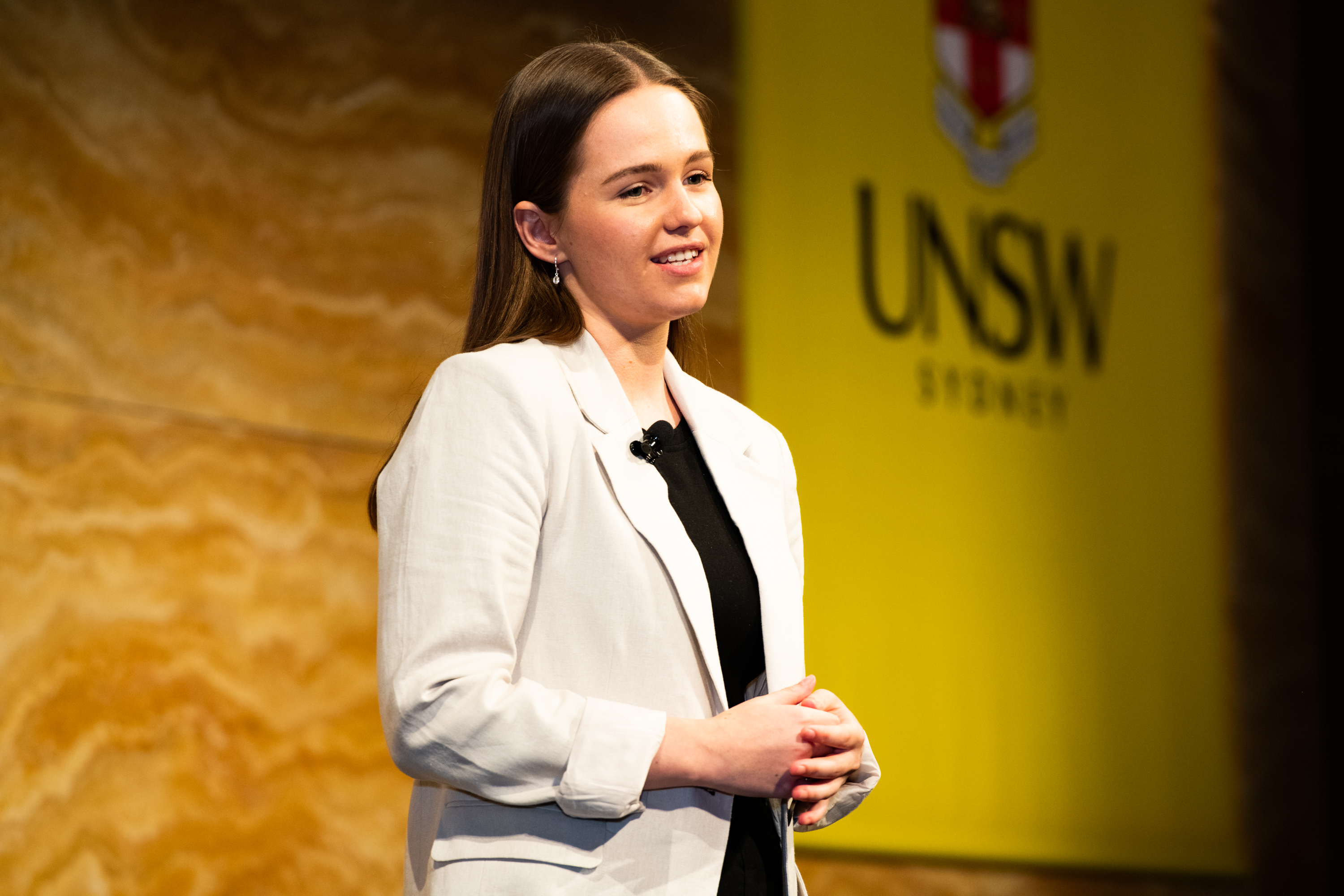
UNSW Pro Vice-Chancellor Research Training and Dean of Graduate Research Professor Jonathan Morris with Benjamin Wu, winner of UNSW's 3MT final 2026.
Photo: Isabella Moore

PhD candidate Benjamin Wu won UNSW’s 3 Minute Thesis competition with his presentation on reversing ageing of the human egg.
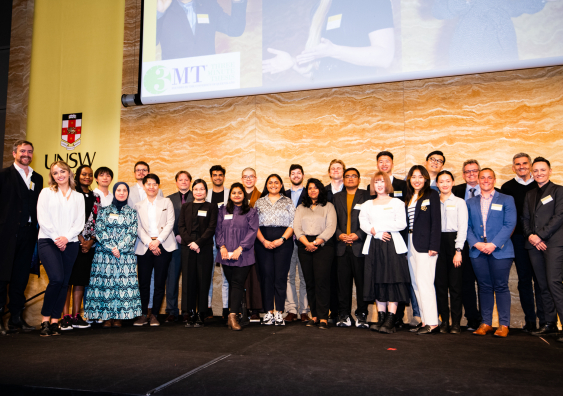
UNSW’s brightest PhD candidates distilled years of research into three-minute presentations at this week’s 3 Minute Thesis (3MT) competition.
Benjamin Wu from the School of Biomedical Sciences won the competition with his research into reversing ageing of the human egg, taking out a $3000 prize and advancing to the 3MT Asia-Pacific at the University of Queensland and Universitas 21 3MT finals.
Mr Wu’s work focuses on reversing the ageing process of the human egg to restore fertility.
“Eggs are naturally surrounded by supportive nursing cells which feed the egg nutrients, allowing it to become the largest cell in the body. Like the egg, these nurse cells age. Instead, if we take young nurse cells from young donors and transplant them to an ageing egg, we might expect the young cells to rejuvenate the ageing egg,” he said.
“To do this, I spent two years developing a delicate procedure, which suspends the egg in time while the nurse cells tend to it, and I've shown for the first time that despite an age gap, these cells can talk to each other.”
Mr Wu hopes his work could ultimately change outcomes for in vitro fertilisation (IVF).
“Fertility doctors define advanced maternal age as women over 35 ... yet, arguably, this is the prime of life, often when there's stability in career, finances, and partner. Achieving these ideals is increasingly difficult and has contributed to a global trend towards later childbearing age,” he said.
“This has dramatically driven demand for reproductive technologies like IVF, but IVF success is fundamentally limited by declining egg quality. By reversing ageing in the egg, my PhD could forever change IVF outcomes.”
Mr Wu started his academic career in Adelaide studying Optometry then practised in the field before pursuing his passion to go into research. After completing his honours year at UNSW, he started his PhD studying under Associate Professor Lindsay Wu in the Laboratory for Ageing Research and Professor Robert Gilchrist in the Oocyte Biology Research Unit.
“Being able to speak in conferences confidently is a good way to convey your research to other scientists and sell your ideas,” Mr Wu said.
“Science is not a business, but if you think that people in the audience might be assessing your grant in future and they will get an impression of you from your speaking, then it is good to put in the effort.”

Other awardees
The 20 speakers presented a wide variety of research from medical breakthroughs to robotics, safer schools, immigration law and how to dry grains more efficiently.
The Faculty of Medicine and Health dominated the competition taking first, second and third places.
Runner up and winner of $1,500 Zoe Vandeleur from the School of Clinical Medicine, articulately detailed her work on how tethering proteins can treat rare diseases.
Third place, Phoebe Dunbabin, from the School of Biomedical Sciences won $500 for her presentation on ‘The unicellular astronaut: How yeast is paving the way for human space travel’.
The People’s Choice Award went to Xingyu Zhang from the School of Mechanical and Manufacturing Engineering for his work on teaching robots the sense of touch.
Sumaya Ishtiaq, from the School of Chemistry, won The Founders Award for her work on creating a way to keep protein biosensors clean for continuous monitoring.
Sarah Tucker was highly commended for her novel approach to addressing recidivism by incorporating art into prisons.
UNSW Pro Vice-Chancellor Research Training and Dean of Graduate Research Professor Jonathan Morris said the presentations showed how UNSW’s PhD researchers are working to improve lives and tackle some of the greatest challenges facing the world today.
“Medicine always does very well. But I think we're seeing across the faculties, people have put a lot of effort into to this, and I think that what we saw tonight is high-quality science communication,” Prof. Morris said.
“Everyone puts a lot of work into this from the school level and the faculty, but there are always opportunities to practice and build on this, so I think that we're lifting the standard.”
The judging panel included Non-Executive Director and Auditor, Pippa Downes, Head of School at Cranbrook Dr Anne Johnstone, Research Engineering Fellow at Orica Dr Armineh Hassanvand, UNSW Deputy Dean of Graduate Research Scientia Professor Fiona Stapleton and UNSW Deputy Vice-Chancellor (Research & Enterprise) Professor Bronwyn Fox AO.
Media enquiries
For interview requests please contact Emma Blake:
Tel: +61 2 9385 2864
Email: emma.blake@unsw.edu.au