
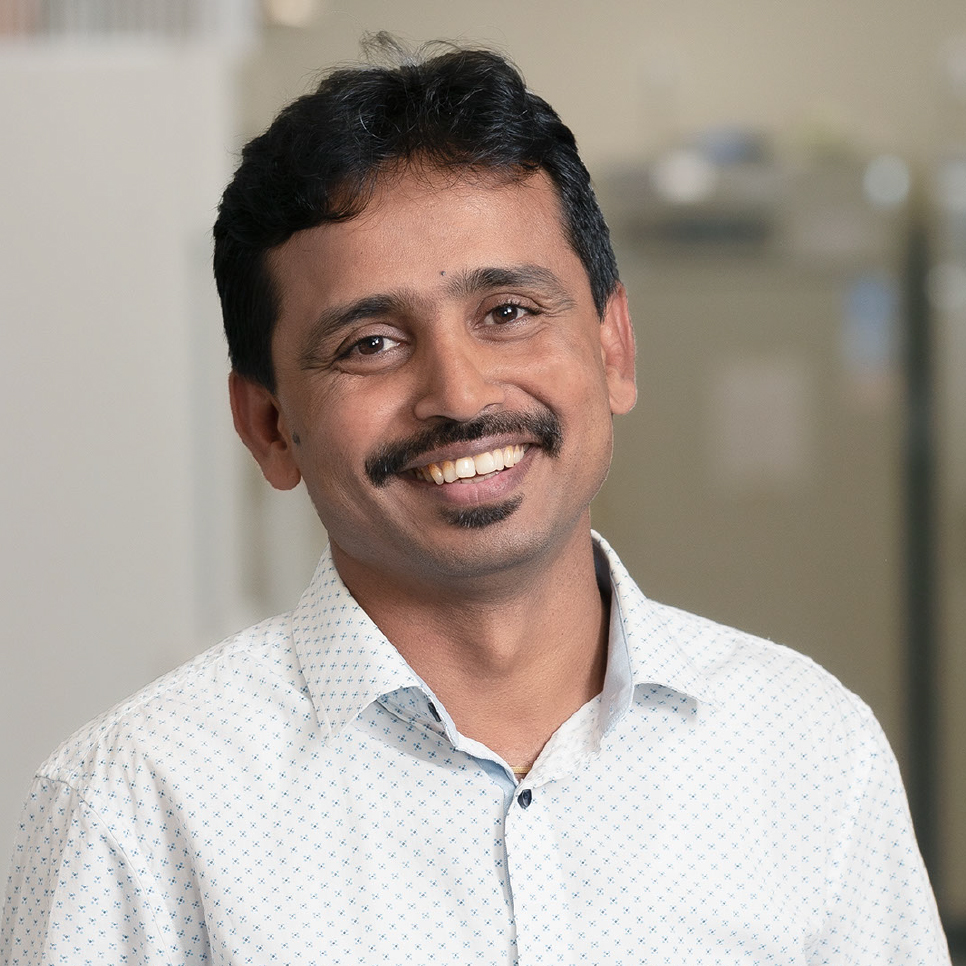
Dr Vaibhao Janbandhu
PhD (Life Sciences), International Centre for Genetic Engineering and Biotechnology (ICGEB), New Delhi, India, 2007
MSc (Molecular Biology and Biotechnology), Indian Agricultural Research Institute, New Delhi, India, 2002
BSc (Agricultural Sciences), Dr PDKV Agricultural University, Akola, India, 2000
Dr Vaibhao Janbandhu is a Senior Staff Scientist in the Developmental & Regeneration Biology Lab at the Victor Chang Cardiac Research Institute and a Conjoint Lecturer at the School of Clinical Medicine, UNSW Sydney. His research aims to uncover the molecular mechanisms of heart disease, with a focus on how cardiac fibroblasts behave in health, injury and disease, and how they can be targeted to limit fibrosis and support repair. His current work extends to fibroblast populations in the aortic valve and their role in aortic stenosis.
Dr Janbandhu’s team combines genetic mouse models with single-cell and spatial multi-omics. In 2021 he and his colleagues discovered a protective response in the heart that limits damage after a heart attack (Cell Stem Cell, 2022). He also co-led an integrated single-cell atlas of cardiac fibroblasts across diverse pathologies (Science Advances, 2024) and developed a mouse model for selectively tagging and purifying cardiac myofibroblasts (Circulation, 2024).
He received the ISSCR Merit Award for Scientific Excellence in 2022. He holds a PhD from the International Centre for Genetic Engineering and Biotechnology (ICGEB) and was a Max Planck Society Fellow at the Max Planck Institute of Biochemistry in Munich.
- Publications
- Media
- Grants
- Awards
- Research Activities
- Engagement
- Teaching and Supervision
Current
2026: St Vincent’s Clinic Research Foundation Grant, Towards Precision Therapies for Valvular Heart Disease through Targeted, Knowledge-Driven Approaches (CIA)
2025-2028: NHMRC IDEAS Grant, Fibroblast PIEZO1/2 channels as biomechanical drivers of cardiac remodelling (CIB; lead CIA Charles Cox)
2025-2027: NSW Cardiovascular Research Capacity Grant, Understanding strain-induced cardiac remodelling and reverse remodelling to predict functional recovery post aortic valve replacement (Associate Investigator; lead CIA Charles Cox)
2025-2026: Tour De Cure Annual Grant, Defining tumour remodelling to halt lung cancer metastasis (CIC; lead CIA Amelia Parker)
Completed
2023: IMPACT Philanthropy Grant, State-of-the-art analysis of heart physiology in animal models of human cardiovascular disease (CIC; lead CIA Richard Harvey)
2023: BGI STOmics Grant, Spatial Transcriptomics to Discover Novel Targets in Cardiac Fibrosis (CIA)
2022: AMR Equipment Grant, Upgrades for Leica Thunder Microscope and AMR Live Imaging Facility (Associate Investigator; lead CIA Michael Lovelace)
2021-2024: NHMRC IDEAS Grant, Crossing a frontier in cardiac fibrosis: a single-cell multi-omics approach to understanding fibroblast agency in models of heart disease (Associate Investigator; lead CIA Richard Harvey)
2015: James N Kirby Foundation Large Grant, A Hypoxia Workstation for characterisation and rejuvenation of cardiac stem cells (CIB; lead CIA Richard Harvey)
ISSCR Merit Award for Scientific Excellence (2022)
Winner, VCCRI Art of the Heart Science Image Competition (2018 and 2020)
Best Postdoctoral Talk Award, Sydney Cardiovascular Symposium (2017)
Young Investigator Award, Stem Cells Australia (2016)
Best Fast Forward Presentation Award, 23rd Annual St Vincent’s Campus Research Symposium (2015)
Max Planck Society Postdoctoral Research Fellowship, Max Planck Institute of Biochemistry, Germany (2008–2012)
Senior Research Fellowship (SRF), Council of Scientific and Industrial Research (CSIR), Government of India (2004)
Qualified National Eligibility Test (NET) and Junior Research Fellowship (JRF) through national competitive examinations: CSIR/UGC, ICAR and ICMR, Government of India (2002–2004). Fellowship held: [CSIR JRF].
Junior Research Fellowship (JRF), Indian Council of Agricultural Research, for M.Sc. studies (2000–2002)
Merit Gold Medal, Dr PDKV Agricultural University, for outstanding academic performance in B.Sc. Agricultural Sciences (2000)
Merit Scholarship, Dr PDKV Agricultural University (1996–2000)
Dr Janbandhu’s research investigates how cardiac fibroblasts shape the heart’s response to injury, pressure overload, valve disease and ageing, and whether these cells can be targeted to limit fibrosis and support repair. His work includes:
Fibroblast biology in heart injury: defining how fibroblasts respond to myocardial infarction, including the role of hypoxia signalling (HIF-1α) in controlling fibroblast proliferation and scar formation.
Single-cell and spatial atlases: building integrated single-cell and spatial maps of cardiac fibroblast states across disease, and developing shared analysis workflows used across institutes, including the public CardiacFibroAtlas.
Genetic tools: developing mouse models for tagging, purifying and manipulating specific fibroblast populations, including cardiac myofibroblasts.
Cardiac ageing: investigating how ageing and exercise alter cell states and the molecular (chromatin) landscape of the heart, and which age-related changes can be modified.
Aortic valve disease: investigating fibroblast populations in the aortic valve and identifying biomarkers of disease activity and recovery after valve replacement.
Mechanobiology: collaborating on the role of fibroblast mechanosensing (PIEZO channels) in cardiac remodelling.
Translational research: studying how drugs already used in patients affect the heart, including SGLT2 inhibitors in heart failure and polyamine inhibitors in childhood cancer, and identifying biological and imaging predictors of cardiac recovery after aortic valve replacement, in partnership with clinicians at St Vincent’s Hospital and the Children’s Cancer Institute.