
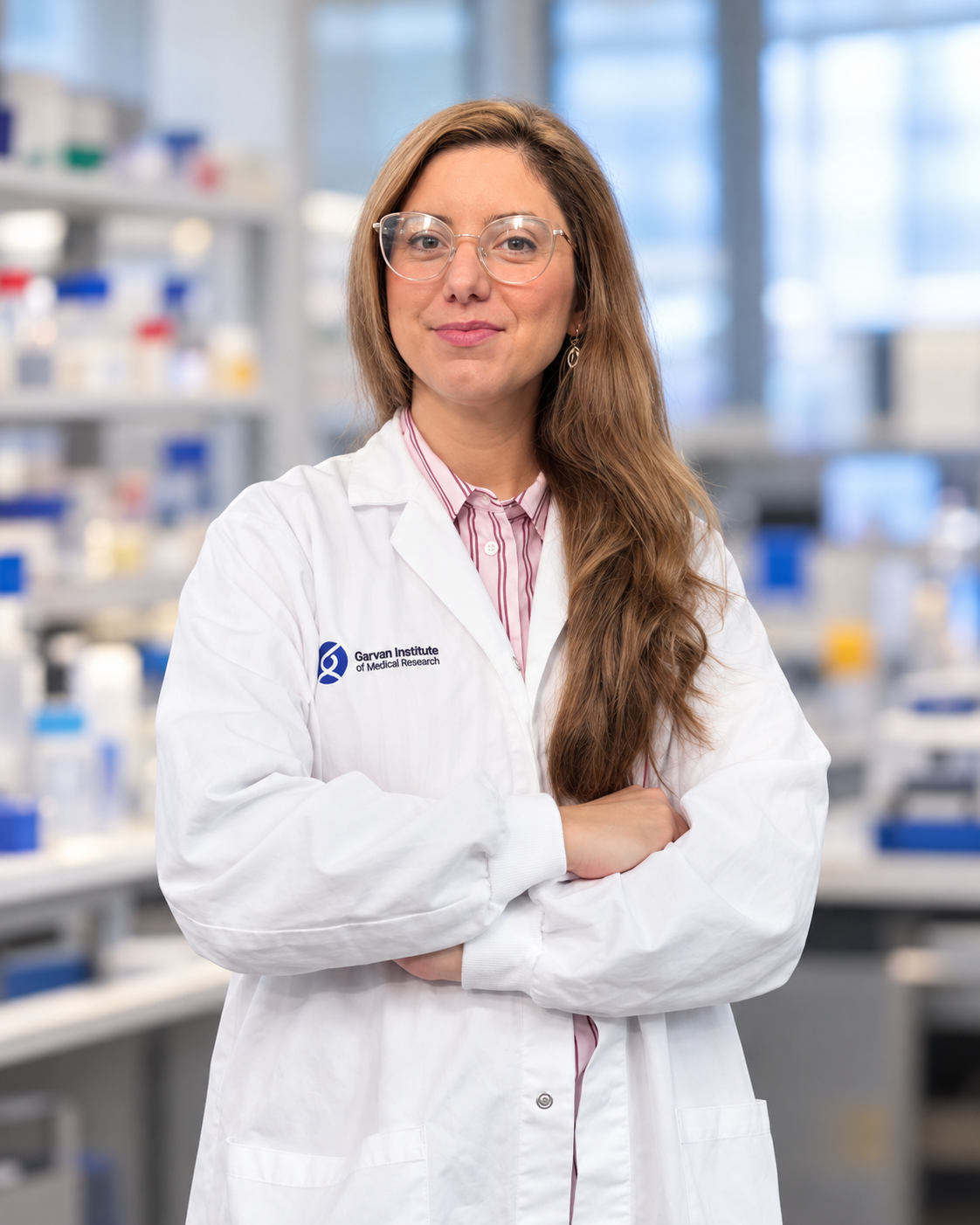
Conjoint Associate Professor Vanesa Maria Quintano Ramos
Conjoint Senior Lecturer
PhD in Molecular and Regenerative Medicine (Biomedicine), University of Modena and Reggio Emilia (UNIMORE), Life Sciences Department, Modena, with the National Research Council (CNR), Bologna, Italy. November 2016 to March 2020, conferred 13 March 2020. Specialisation in nanotechnologies and modelling for industrial biomedical applications. Thesis: Selective ion transport in graphene-based membranes for sensing and biomedical applications.
MSc Advanced Studies in Chemistry (Biochemistry), University of Seville, Department of Chemistry, Spain, 2014 to 2015. Specialisation in structural elucidation and characterisation of materials.
MSc Microbiology Applied to Industrial Biotechnology, University of Seville, Department of Pharmacy, Spain, 2013 to 2015. Specialisation in antitumorals and DNA technology.
Licenciatura in Chemistry, University of Seville, Department of Chemistry, Spain, 2008 to 2014.
Clinical Drug Development: Clinical Trial Methodologies and Innovations, Harvard Medical School (HMX online), Boston, 2026.
Good Clinical Practice (GCP), Faculty of Medicine, Autonomous University of Madrid, 2020 to 2021.
Theoretical and Practical Foundations in Cell Culture, Biobank of the Andalusian Public Health System, Biomedical Research Centre, University of Granada, 2021.
Medicine & Health
School of Clinical Medicine
Dr Vanesa Quintano Ramos is a Research Officer in the Connie Johnson Breast Cancer Research Laboratory at the Garvan Institute of Medical Research, and holds a conjoint appointment in the School of Clinical Medicine, UNSW Medicine & Health.
She leads the in vivo patient-derived xenograft programme in the Lim laboratory and coordinates its collaborations across UNSW Medicine & Health, UNSW Science and international partners.
Dr Quintano Ramos trained originally in chemistry and nanomaterials, completing a PhD in Molecular and Regenerative Medicine at the University of Modena and Reggio Emilia in 2020, followed by a Marie Sklodowska-Curie Global Fellowship held jointly between UNSW and the Catalan Institute of Nanoscience and Nanotechnology in Barcelona, developing electrochemical biosensing platforms for circulating microRNA detection. She now connects that work to longitudinal monitoring in preclinical breast cancer models. She has also worked outside academia as a scientific consultant and innovation adviser, assessing research and development projects across the life sciences for industry and government.
E-mail
- Publications
- Media
- Grants
- Awards
- Research Activities
- Engagement
- Teaching and Supervision
Estee Lauder Companies Breast Cancer Research Award, Garvan Institute of Medical Research, 2026.
Marie Sklodowska-Curie Actions Postdoctoral Fellowship (Global), GraBBIng, grant agreement 101066462, 2022 to 2025. Host: UNSW School of Materials Science and Engineering, with ICN2, Barcelona.
UNSW Cancer Research Theme Grant, 2026.
Estee Lauder Companies Breast Cancer Research Award, Garvan Institute of Medical Research, October 2026.
Marie Sklodowska-Curie Actions Postdoctoral Fellowship (Global), European Commission, 2022.
Marie Sklodowska-Curie Actions Innovative Training Network Fellowship, CNR Bologna, 2016 to 2018.
Hormone receptor signalling in breast cancer, with a focus on how tumour histology shapes response to endocrine therapy.
Preclinical in vivo models. Clinically annotated patient-derived xenografts for evaluating therapeutic strategies in hormone receptor positive disease.
Mechanisms of treatment resistance and late recurrence.
RNA-based biomarkers and liquid biopsy. Circulating microRNA detection and electrochemical biosensing for monitoring treatment response.
Tumour microenvironment and engineered three-dimensional models.