Finance, climate and the human problem: meet ICRR’s new Senior Deputy Director
Published on the 19 August 2026 by Melissa Lyne, UNSW ICRR


Associate Professor Kristle Romero Cortes never expected to become Senior Deputy Director of the UNSW Institute for Climate Risk & Response. But for a finance researcher who can see how climate change increasingly touches every decision we make, the role is a natural fit.
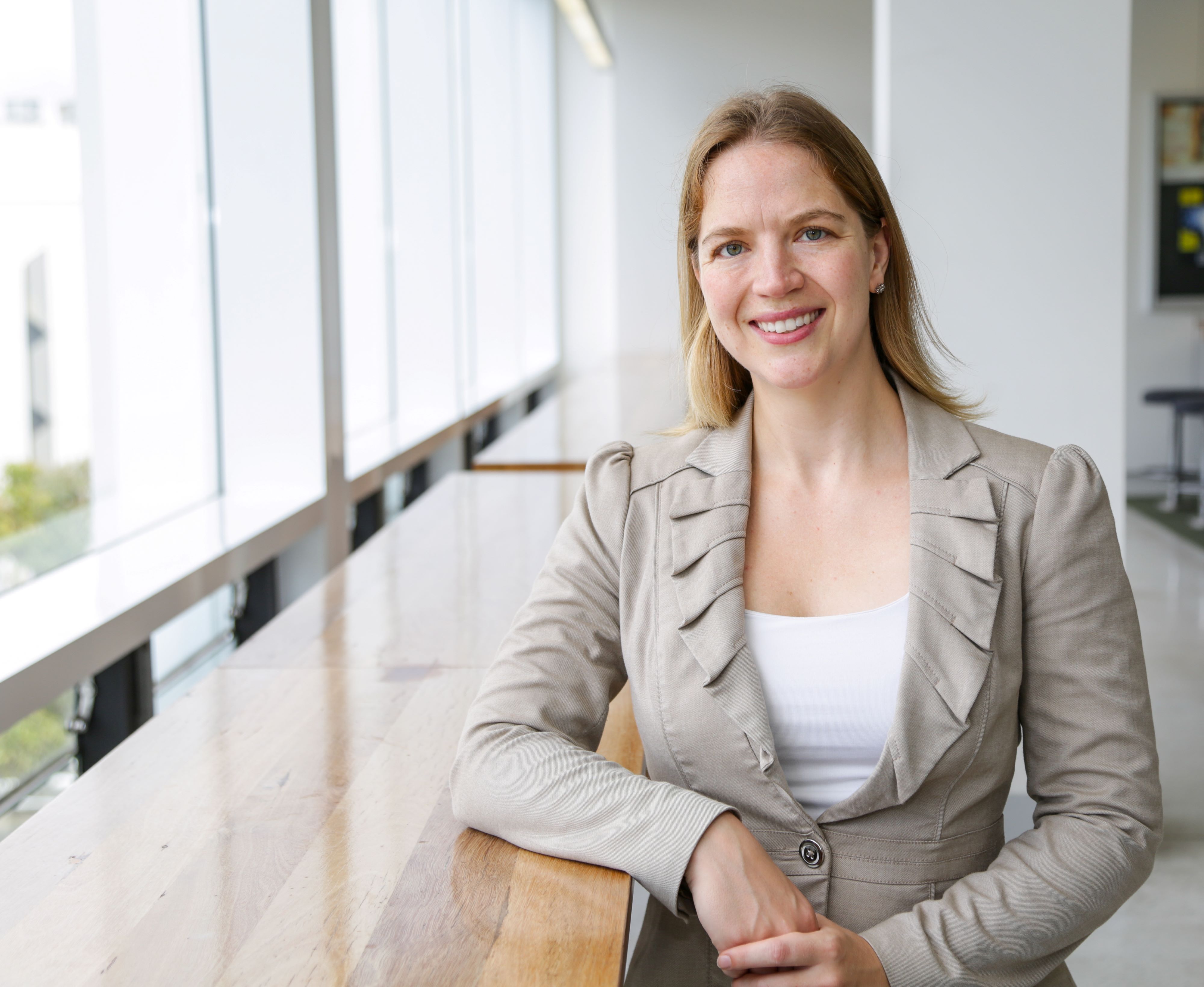
Associate Professor Kristle Romero Cortes says being Senior Deputy Director of the UNSW Institute for Climate Risk & Response (ICRR) was “not on my bingo card”.
However, her first internship, while an undergraduate in the United States, was at the Chicago Climate Exchange, where she worked with a team examining how major US companies could voluntarily reduce their carbon emissions.
Years later, during her PhD, she studied how lenders move capital following natural disasters and the role local banks can play in helping communities recover.
While climate change was never the sole focus of her research, A/Prof. Romero Cortes says it has increasingly become impossible to separate it from the financial and economic questions she studies.
“Climate is baked into everything at this point, whether we study it specifically or not,” she says. “We really need to stop seeing it as another thing.”
Instead, she says, climate change is increasingly shaping other challenges – from household finances and insurance to investment decisions and the resilience of entire communities.
A/Prof. Romero Cortes has been involved with ICRR since it was first launched in 2023, when she approached the then Business School Dean to ask how she could participate in the new institute.
She was curious as she was already seeing in her own field how climate risk was moving from the margins of financial decision-making towards the centre. An example being one of the biggest financial decisions most people will ever make – buying a home.
She says affordability has traditionally dominated the question of where people buy. But, increasingly, another calculation needs to enter the equation.
“That’s whether or not you want to be buying that home in that place, because it could be underwater or on fire in 10 to 20 years,” A/Prof. Romero Cortes says.
She says the same questions flow through banking, lending and insurance.
Researching the way banks respond to disasters has shown her how financial institutions can contribute to resilience, including by working with borrowers following a major shock.
“It’s not status quo that you’re constantly having climate shocks,” A/Prof. Romero Cortes says.
“That sadly is changing, where now we see the 100-year floods happen every 10 years.”
She says she has been asked ‘What does economics have to do with climate?’
“Finance or economics and law are pieces to the solution,” she says.
“The problem may be defined and measured with science and models, but the solutions are going to include humans – and humans are the hardest part.”

That human dimension is one reason A/Prof. Romero Cortes was attracted to ICRR.
The Institute brings together researchers from science, business, law and other disciplines to understand not only the physical risks posed by a changing climate, but how governments, businesses and communities can respond.
Interdisciplinary research is easy to champion, she says. But doing it well is much harder.
Academics are trained deeply within their disciplines, with different methodologies, terminology, publishing cultures and measures of success. But this doesn’t mean they are necessarily taught how to work across other boundaries.
“The institute is really a trailblazer in that sense,” she says.
A/Prof. Romero Cortes says she is “not a quiet person” and has deliberately spent her early days in the role asking questions and absorbing the perspectives of people across ICRR and UNSW more broadly.
Her methods are reflected in her own research, where she talks to the people working inside of banks, asking if her research makes sense in the context of the decisions they make.
She hopes she can help strengthen ICRR’s connections with industry, government and regulators while also supporting academics to get their research in front of the people who can use it.
“The institute is there to facilitate people’s work – their research, their teaching and their engagement with industry or with regulators or in government,” she says.
“The academics themselves don’t need to be doing more or different work.
“But I do think they just need to really be getting credit for everything they’re currently doing.”
A/Prof. Romero Cortes is wary of communicating climate change in ways that are negative – where people can conclude the problem is simply too large to confront. But she is equally wary of optimism that glosses over the difficult reality ahead.
“The realistic, pragmatic piece of it is very daunting – people will just put their heads in the sand. They’ll be like, ‘There’s nothing we can do, so let’s go to the beach’,” she says.
“Climate isn’t sexy anymore. And that’s perfect, because we don’t want to be sexy. We want to be serious. This is serious. It was never a fad.”
She sees climate change increasingly moving into the spheres of people who might once have had little reason to work together – a banker with a physicist, for example, or a behavioural psychologist with a lawyer.
The opportunity she sees is to help bring those different pieces together and translate rigorous research into decisions that make sense in people's everyday lives.
A/Prof. Romero Cortes says universities have a particularly important role to play in that process – in providing trusted research, bringing together expertise and creating pathways between academics and those making decisions.
Looking five years ahead, her measure of the Institute’s success is people-focused – helping UNSW researchers achieve greater impact from the work they are already doing.
“We’re purpose driven here."
It is a serious mission, she says, but that doesn’t mean there’s no joy in doing the hard work.
“My personal motto is to have fun. If you’re not having fun, why are you doing it?" she says.
“Let’s all dig in and let’s problem solve.”
 Featured expert
Kristle Romero Cortés