Teaching future leaders how to merge profit and sustainability
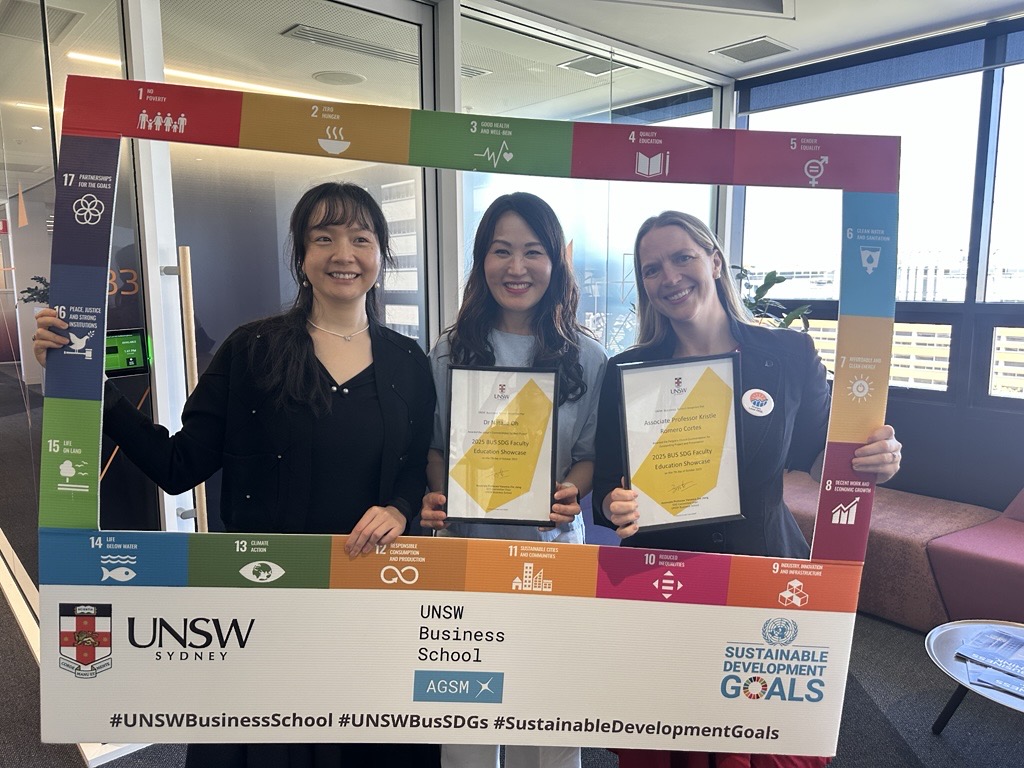
Associate Professor Kristle Romero Cortes' award-winning course project is giving students the skills to think critically and ethically in the boardrooms of the future.
Associate Professor Kristle Romero Cortes, School of Banking and Finance, UNSW Business School, has always been intrigued by the idea of unintended consequences. Like flexible working conditions leading to empty office spaces. Or the rise of the internet completely changing how we shop.
That's why she's spent most of her career in finance and academia looking at the bigger picture – and why her innovative approach to teaching real estate finance recently earned the People's Choice Award at the SDG Education Awards.
“I've always been fascinated about how financial systems influence people's lives,” she says.
“As an academic, I have the space to think about this, turn it upside down, ask questions, and interrogate them. And when you can think about those questions deeply, you can translate the findings into policy that helps people do good by doing well.”
And now she’s helping third-year UNSW students think like ethical leaders through her elective course project, Embedding the Sustainable Development Goals (SDGs) into Real Estate Finance.
Australia’s obsession with real estate has been around since the turn of the 20th century. And a consistent focus on property’s potential financial upsides has been fuelling the fire.
But profit isn’t the full story, according to Associate Professor Romero Cortes.
“The capital gains you can make in both commercial and residential real estate have been sensationalised. But what’s becoming equally important is understanding what's going to happen in the next five or ten years for a particular location,” she suggests.
She’s not talking about gentrification or demand for the area.
“It’s about liveability. Will the house be standing in 20 years? Or will it be underwater? While the risk-return model hasn’t changed, what defines risk needs to be broadened.”
The other misconception Associate Professor Romero Cortes wants to bust is that doing good and doing well are mutually exclusive.
“Doing the right thing from a sustainability point of view could actually reduce your exposure to risk.
It could allow you to invest in areas that have potential growth opportunities and move away from other areas that are going to decline.”
To debunk these myths and teach students to incorporate the bigger picture into their decision-making processes, Associate Professor Romero Cortes developed the “Embedding the SDGs into Real Estate Finance project” as part of her Real Estate Finance elective course.
Traditionally, finance education focuses on quantitative analysis and return metrics. But tomorrow’s leaders also need to know how to integrate sustainability, climate resilience, and social equity into their financial decisions.
In its fourth year, Associate Professor Romero Cortes’ project reframes real estate finance as a discipline where practitioners use traditional valuation and investment tools alongside ESG considerations. And by splitting the project into two stages, students have the opportunity to experience how SDGs intersect with financial outcomes.
In Stage 1, students take on the role of an individual property buyer, looking at affordability pressures, financial and climate risk, and resilience planning. This stage also links housing access and financial decision-making to broader social outcomes.
“Buying a house is a very personal thing. But what’s often underestimated is whether or not you should buy that house. Will it be standing in 20 years? We want to show our students that they can make good financial decisions with the SDGs in their sphere.”
In Stage 2, students re-evaluate the same property as a real estate investment manager or trust, applying institutional tools, environmental, social and governance (ESG) analysis, and fiduciary decision-making.
“For example, they look at the building's LEED certificates or Green Star rating, which helps them start to appreciate what it means to be in the built environment from an ESG perspective,” explains Associate Professor Romero Cortes.
Associate Professor Romero Cortes has a simple philosophy when it comes to teaching.
“I teach the way I hope someday someone will teach my own children. There are high expectations, but there's clarity and fairness in the classroom. The instruction is there so people engage with the material.”
And she uses this approach to pass on her passion for harnessing finance as a force for positive social and environmental change to her students.