
First year of Lower Balonne waterbird surveys
Five waterbird survey trips were conducted at 10 Narran Lakes Nature Reserve sites in 2024-2025 in collaboration with our partners. Inundated parts of the wetlands supported abundant waterbird activity throughout the year.
The number of waterbird species recorded during each survey period was:
- August – 28 species
- October – 39 species
- December – 20 species
- February – 42 species
- May – 28 species.
The observation of 42 species in February was the highest number of species recorded in one survey period since the NSW National Parks and Wildlife Service (NPWS) commenced waterbird ground surveys in the Reserve in spring 2012. As a comparison, very few waterbird species (<5 species) were recorded when the wetlands were mostly dry in the spring of 2014, 2015, 2017, 2018 and 2019 annual ground surveys.
Over the 2024-2025 surveys, four NSW threatened waterbird species were recorded. These were the black-necked stork (Ephippiorhynchus asiaticus), brolga (Antigone rubicunda), blue-billed duck (Oxyura australis) and freckled duck (Stictonetta naevosa).
One federally listed species, the sharp-tailed sandpiper (Calidris acuminata), was also recorded.
Data was collected from five acoustic recorders. The team are now undertaking the monumental task of analysing thousands of hours of acoustic recordings. This is not done just digitally. It requires manual listening to calls to confirm the accuracy of the species detections.
This data, together with this year’s observations and existing NPWS data, will be used to compile the results for the first year of Flow-MER waterbird monitoring and will be delivered later this year. The results will further inform water management decision-making.
The surveys were jointly run and funded by Flow-MER and the NSW Department of Climate Change, Energy, the Environment and Water (NSW DCCEEW) with support from the NSW NPWS.
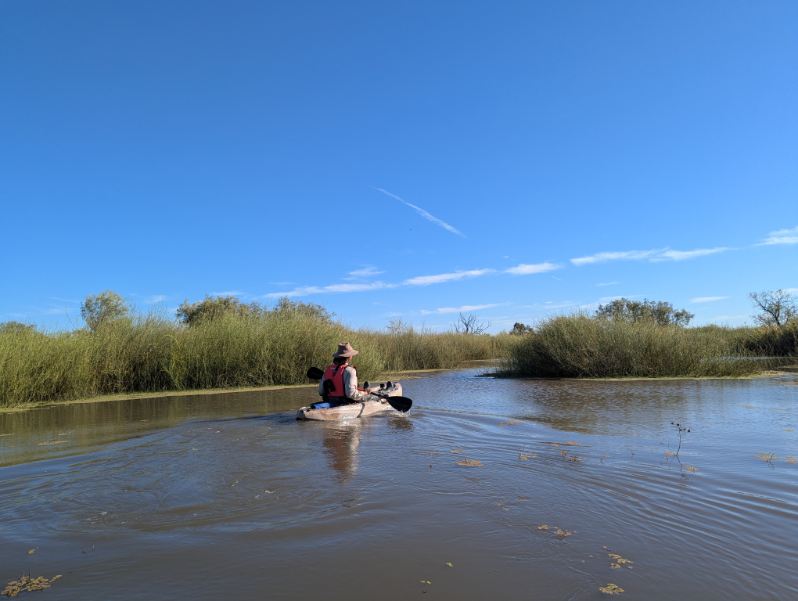
Pelican Lagoon north of Clear Lake. Paddling out to check on solar bars deployed in the lignum (Image: NSW DCCEEW).