Engineering Microstructures Group
Our mission is the design and discovery of next generation structural metallic materials

Our mission is the design and discovery of next generation structural metallic materials


Our approach is to unlock better properties than currently available by engineering of the inner structure of metals and alloys. The purpose is to make them fit for high-performance applications such as next-generation aerospace, tooling, defence, energy, and more.
We are one of the leading physical metallurgy groups in Australia and most well-known for our research on Ni/Co-based superalloys, Ti-based alloys, and stainless steels. These materials are made via advanced thermo-mechanical or metal additive manufacturing routes. We have keen interests in developing more sustainable processing routes for materials. We combine state-of-the-art experimental techniques such as correlative microscopy with mechanical testing and contemporary modelling approaches, all across multiple length scales.
Our research philosophy is to achieve a balance between fundamental discovery and industrial application. We are excited about developing the next generation of structural metallic materials in collaboration with industrial partners.
We have strong international networks with groups in Europe and the US, and this includes universities, national labs, industry, and defence.
Find out more about our group leader Prof. Sophie Primig.

Our team of undergrad researchers, PhD students and postdoctoral researchers is diverse. Our current and recent team members are from six different continents with passports from countries including Australia, Austria, Brazil, Cambodia, China, Ghana, Germany, India, Indonesia, Iran, Italy, Nigeria, the UK, the USA, and Vietnam. Our PhD students have backgrounds in materials science and engineering, chemical engineering, metallurgy, mechanical and manufacturing engineering, or related. We speak many languages and enjoy activities like drinking coffee, coastal walks, Aussie BBQs, or bowling besides research. Our alumni have found exciting roles in industry, academia, and national labs.
We aim to recruit 2-3 new PhD students every year. Current projects are in advanced thermo-mechanical processing of alloys, metal additive manufacturing, sustainable materials processing, and/or microscopy technique development.
Funding to support competitive applicants is available. Note: UNSW PhD stipends are now >$40k tax free p.a.!
Please note that any openings for Post Doctoral researchers are advertised via UNSW jobs. We cannot accept email applications for such roles.
We offer access to world-class facilities, a great international network, conference travel, team spirit, and more. Please check Sophie's UNSW profile page and UNSW scholarships website for information on what skills you should bring.
We welcome to collaboration requests by industry. We are interested in consulting, ARC Linkage projects and directly industry-funded research on alloy processing and development.
We are keen to pursue new academic collaborations with peers who possess complementary skills in metallurgy or suitable interdisciplinary skills enabling us to tackle grand challenges.

Our physical metallurgy labs based in the UNSW School of Materials Science and Engineering house state-of-the-art facilities for fabrication (casting and 3D printing), thermal and thermo-mechanical processing of structural alloys.
The photo shows one of our vacuum arc-melting facilities for synthesis of model alloys. Our Gleeble 3500 is a thermo-mechanical testing simulator that can be used to simulate real-world processing on lab scale and measure mechanical properties at high temperatures, for example for ductility testing. High heating and cooling rates enable studies of the effects of thermal cycling, similar to additive manufacturing.
Further state-of-the-art alloy processing facilities via melt metallurgical routes and metal 3D printing are available in-house, and via our local and international networks with leading research groups and industrial partners.

Our team are expert users in electron microscopy (SEM and (HR-)TEM), related techniques (EDX, FIB/P-FIB, (3D)-EBSD, TKD, EPMA), XRD, and 3D atom probe microscopy. We routinely use these techniques in a correlative manner to investigate the inner structure of alloys at the micro- and nano-scale. This enables us to reveal structure-property relationships as a function of processing history.
We have access to state-of-the-art high-resolution characterisation facilities at the UNSW Mark Wainwright Analytical Centre, including the Electron Microscopy Unit. This includes several SEMs, focused ion beam (FIB) microscopes including a tribeam plasma and laser ablation FIB, many equipped with EBSD/EDX, several TEMs, XRDs, and an electron micro probe analyser.
Microscopy Australia and international collaborations enable smooth access to any required state-of-the-art structural characterisation technique underpinning our research. Most significantly, many of our team are expert users in atom probe microscopy, for performing 3D spatial and compositional analyses of alloys.
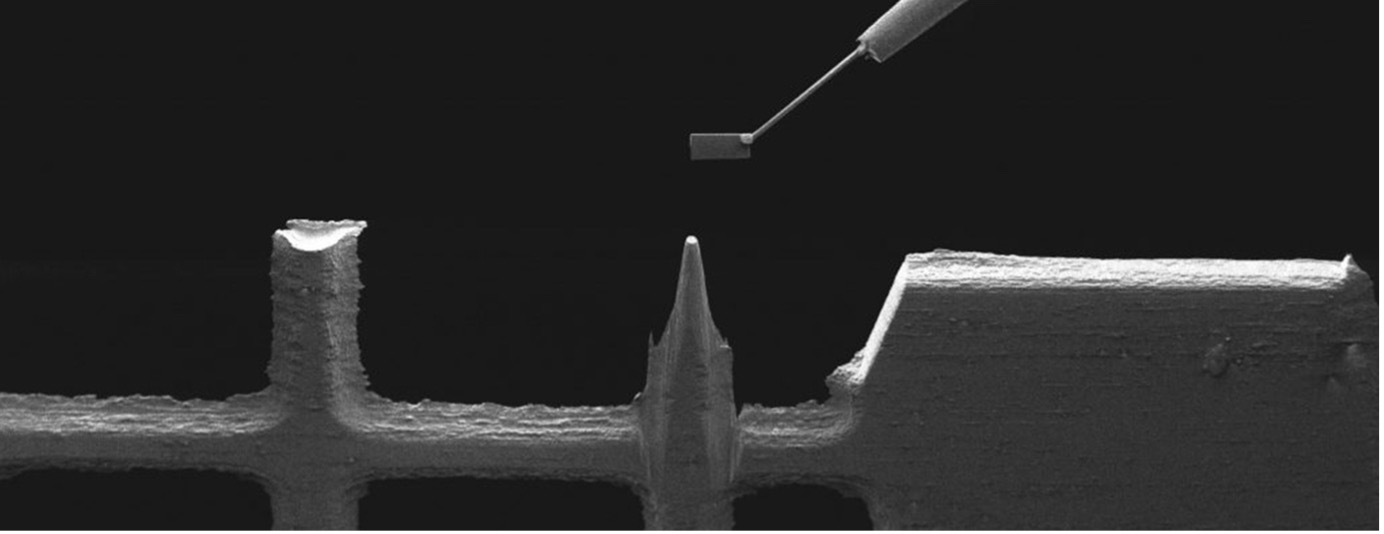

In our research, we aim to engineer the inner structure of alloys via advanced processing, to unlock better properties than currently available.
To support this effort, several tools for thermal analysis, metallography, (thermo-) mechanical testing, as well as various techniques for measurements of functional materials properties are available within the UNSW School of Materials Science and Engineering.
For example, macro-scale quasi-static mechanical tests are conducted using tensile and compressive testing equipment by Instron. This allows the evaluation of key mechanical properties such as Young's modulus, yield strength and ultimate tensile strength. Where high strain rates are required, we use Charpy impact testing. Using these tests, we gain insights into the impact toughness and evaluate the brittle-to-ductile transition temperature of alloys.
Outstanding facilities for micro-mechanical testing (nano-indentation, in-situ testing), high-temperature mechanical testing (e.g. creep), corrosion testing and more are available in-house, and via national and international collaborations.

Our approach to research is to correlate our multi-scale characterisation and testing results with state-of-the-art modelling techniques across several length scales.
The team of engineering microstructures in the UNSW School of Materials Science and Engineering are expert users of CALPHAD (for predicting phase diagrams) and thermo-kinetic modelling of processing of structural alloys. The latter enables the prediction of phase transformations and through-process modelling of the microstructural evolution and mechanical properties. Tools available in our group are ThermoCalc, Dictra and MatCalc.
Other modelling techniques across several length scales may include finite element modelling at the macro-scale or first-principles at the atomic scale. These are available in-house or via national and international networks with industry and academia.