
CDEV3500 / CDEV6500
Sustainability & Innovation Lab
Collaborate with students in this interdisciplinary course to tackle UN Sustainable Development Goals, while enhancing your innovation and entrepreneurial skills.

Sustainability & Innovation Lab gives you the opportunity to learn how to use innovation, entrepreneurship, and problem-solving to contribute to addressing sustainable development challenges.
You’ll build skills in innovation, entrepreneurial thinking and problem-solving while learning from people and organisations working to address sustainability challenges in our community.
Available in Summer Term, Term 1, Term 2C, and Term 3, Sustainability & Innovation Lab is a 6 unit of credit (UOC) course available as a general education or free elective for undergraduate students through CDEV3500 and postgraduate students through CDEV6500.
It is an opportunity to expand your network and shape positive change beyond the classroom.
2027
Did you know that one in four UNSW students has skipped a meal because of financial hardship, while Arc’s Food Hub recorded more than 65,000 visits in 2024?
Food insecurity extends well beyond campus. Research indicates that half of renters in NSW experience food insecurity, while 1.2 million Australian children live in food-insecure households. At the same time, Australia discards 7.6 million tonnes of food each year, around 70% of which is edible. That is enough food waste to fill the Melbourne Cricket Ground 10 times.
In 2027, the Sustainability & Innovation Leader Lab will explore how we can respond to this challenge. Working in interdisciplinary teams, you’ll examine the opportunities and challenges of circular economy approaches and prototype practical solutions with the potential to create meaningful change.
Term 2C 2027
In Term 2C 2027 the Sustainability & Innovation Lab will be offered in partnership with Hiroshima University in Sydney. In this term, students will have the opportunity to collaborate with Hiroshima University students during the course.
United Nations Sustainable Development Goals
Through this course, you’ll contribute to progress towards three United Nations Sustainable Development Goals:

2. Zero Hunger
3. Good Health and Wellbeing
11. Sustainable Cities and Communities
You’ll also strengthen your creativity, collaboration, communication, digital literacy and problem-solving skills.
Join Sustainability & Innovation Lab and help design practical responses to food insecurity, a real-world challenge affecting communities right now.
Course details and eligibility
- Worth 6 units of credit (UOC) and available as a General Education or Free Elective course.
- Uses the standard UNSW grading scheme.
- Applies problem-based learning, with students working in interdisciplinary teams to explore how leadership, innovation and entrepreneurship can respond to a complex, real-world sustainability challenge.
- Concludes with a team pitch to stakeholders, presenting a potential solution to the challenge. The assessment is completed as a group, with students marked individually.
- Course lecturer: Petra Stark.
More information
View the course handbook:
- CDEV3500 Sustainability & Innovation Lab (undergraduate)
- CDEV6500 Sustainability & Innovation Lab (postgraduate)
For more information, email the Experiential Learning team at el@unsw.edu.au.
Please be advised that Experiential Learning does not have visibility over individual students’ study progressions. As such, we are unable to confirm your eligibility to enrol in the course. It is the student’s responsibility to consult with their faculty or academic advisor to confirm eligibility and ensure alignment with their study progression and graduation requirements.
Check your eligibility
- Self-check with myPlan
- Enquire with The Nucleus
No space in your program? Submit a Course Substitution Request
Students share their experience
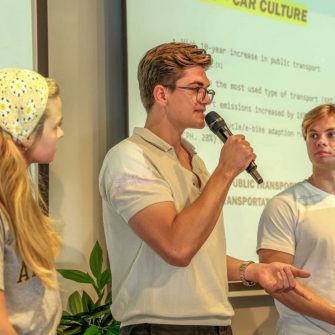
"A particular strength of the course was its in-depth examination of the Circular Economy, which not only deepened my knowledge of this topic but also revealed the potential for innovative solutions to emerge from reframing traditional problems."
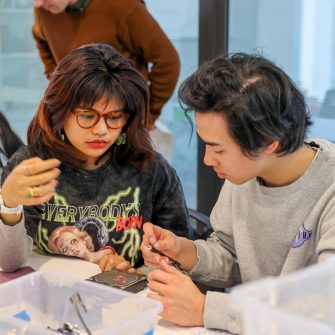
"Everything I’ve learned has made the future I want so much clearer. You get to be really hands-on with your learning, meet a variety of experts in different fields, and grow alongside a cohort of students from diverse backgrounds."