
Physics Incursions and Excursions for Schools
The UNSW School of Physics offers engaging, curriculum-aligned programs for school groups of all ages. Whether you prefer an incursion at your school or an excursion to our Kensington Campus, we make physics accessible, interactive, and genuinely fun.

Option 1 - Incursion
We come to you
Can't make it to campus? Our team brings the stars to your school. The UNSW mobile planetarium travels to you — within 30 km of Kensington.
Available: Planetarium only | Min. 60 students
Option 2 - Excursion
Your students visit UNSW
Full or half-day visits to our Kensington campus. Mix and match activities — lab tours, experiments, planetarium, and campus tours.
Available: Various physics activities | Year 3 to Year 12
What we offer
Choose the experience that suits your students. Mix and match activities for excursions. Select a program below to see details, pricing, and what's included for incursions and excursions.
-
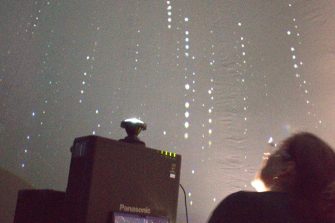
Guided by our team, students explore the night sky and navigate the solar system in an interactive session designed to spark curiosity about space science. Our Astro Planetarium offers an immersive journey through the universe. Inside the portable dome, students explore the night sky, trace constellations, discover planets and galaxies, and the position of the Milky Way and its supermassive blackhole, Sagittarius A*.
Incursion - We come to your school
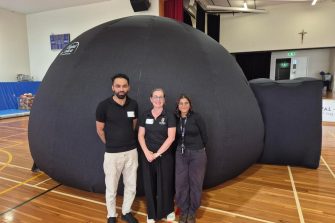
We bring the portable dome to you. Students lie back and explore the night sky in a fully immersive 30-minute session. Topics can be tailored - planets, stars, galaxies, or black holes.
- 30-minute sessions per group of up to 20 students
- Minimum 60 students required per incursion
- Within 30 km of UNSW Kensington Campus
- Must be set up indoors — gym or large hall ideal
Availability: Year round
For fewer than 60 students, please visit us on campus instead - same dome, same experience.
Non-Gateway Schools $1,200 / full day
Gateway Schools $600 / full day




Excursion - Visit us on campus
Gateway Schools and smaller group excursions can visit our Kensington campus to experience the planetarium on-site.
- Recommended for groups of under 60 students
- Immersive 30-minute dome experience
- All ages welcome as part of an excursion day
- Can be combined with lab tours, experiments or a campus tour
Please note that the planetarium does not depend on university course scheduling. Please send your preferred date for this activity with your enquiry.
Non-Gateway Schools $1,200 / full day
Gateway Schools $600 / full day

-
Give students insight into real-world STEM careers through guided tours of research facilities within the UNSW School of Physics. Lab Tours run for 1–1.5 hours, subject to availability, and demonstrate the vast difference between a school laboratory and a world-class research facility.
- Laser laboratories
- Cutting-edge quantum technology facilities
- Fabrication and clean room facilities
- Low-temperature measurement systems
- Helium recovery infrastructure
- High school students recommended
- No minimum student numbers
- Excursion only
See term time availability.
Non-Gateway Schools $50 per group
Gateway Schools Free


-
Bring your physics class to UNSW and allow your students to conduct experiments in our first-year teaching laboratories. Students work in pairs with university-level equipment to collect and analyse data in an authentic research environment.
- Facilitated by current university physics students and staff
- Approximately one demonstrator to every 12 students
- Digital worksheets and experiment guides provided
- Designed to complement the Stage 6 Physics syllabus, supporting depth studies and practical investigations
- Senior student excursions can include up to two laboratory experiments in a day
Note: Availability is limited, as our laboratories are used for undergraduate teaching during university terms. See booking windows for availability.


-
Browse our range of experiments and select options that align with your senior curriculum, whether for depth studies or broader coursework.
-
Led by UNSW Future Students, campus tours are a great complement for students approaching the end of school who are yet to explore a university campus. Included at no extra cost as part of any physics excursion.
- 30 - 45 minutes, subject to availability
- Guided by the UNSW Future Students team
- Self-guided option also available
- Included free with any physics excursion booking
All schools Free - included with excursion


Design Your Excursion
Our schedules are flexible to suit your needs. When completing the enquiry form, let us know which areas of physics interest your students most. Below are example schedules to help you plan your day.
Primary & Junior Secondary
Year 3 – Year 10
Choose from: Planetarium · Lab Tours · Campus Tour
Senior Secondary
Year 11 – Year 12
Choose from: Planetarium · Lab Tours · Lab Experiments · Research Talks · Campus Tour
-
Start your day on campus between 9:00 am and 10:00 am.
Example A
Full day | Year 11–12
Two experiments + research talk
9:00 am
Arrive, School of Physics, UNSW Kensington Campus
9:10 am
First-year laboratories — Experiment 1
11:00 am
Break
11:30 am
Research Talk
12:00 pm
First-year laboratories — Experiment 2
2:00 pm
School of Physics tour
2:30 pm
Depart campus
Example B
Full day | Year 11–12
Experiment + lab tours + planetarium
9:00 am
Arrive, School of Physics, UNSW Kensington Campus
9:10 am
First-year laboratories — Experiment 1
11:00 am
Break
11:30 am
Lab Tours — quantum, helium liquefier, clean room
12:30 pm
Break
1:00 pm
Planetarium
2:30 pm
Depart campus
-
Example C
Half day | High school or Primary
Lab Tours + Planetarium
9:00 am
Arrive, School of Physics, UNSW Kensington Campus
9:10 am
Lab Tours — quantum, helium liquefier, clean room
11:00 am
Break
11:30 am
Planetarium
1:00 pm
Organised campus tour, or depart UNSW Campus
Example D
Half day | High school
Lab Tour + Lab Experiment
9:00 am
Arrive, School of Physics, UNSW Kensington Campus
9:10 am
Quantum Lab Tour
11:00 am
Break
11:30 am
Lab Experiment
1:00 pm
Organised campus tour, or depart UNSW Campus
Costs
Our programs are delivered by UNSW staff and PhD candidates. In recognition of their expertise, all facilitators are paid and programs are run at cost. All prices are subject to GST.
For a list of eligible Gateway Schools, see the Gateway Schools Program information page.
Ready to book for 2026?
Our laboratories support active research and undergraduate teaching, so bookings are scheduled around the academic calendar. Spaces fill quickly - get in early.
Available booking windows 2026
Subject to availability, we are currently offering weekday bookings during the following periods.
- 11 - 29 May
- 24 August - 11 September
- 30 November - 17 December
- UNSW Open Day: Saturday, 5 September 2026
Please note that the planetarium does not depend on university course scheduling. Please send your preferred date for this activity with your enquiry.
Have questions first?
Reach out through email: schools@phys.unsw.edu.au