
Artificial intelligence is transforming intelligent sensing, robotics and autonomous systems, but today’s AI hardware can consume substantial energy because memory and processing are physically separated. Neuromorphic computing takes inspiration from the brain to develop energy-efficient hardware for edge AI, intelligent sensing and brain-inspired computing. In this project, the student will use Python and circuit simulation to build and investigate artificial neurons that integrate, fire, spike and oscillate, and artificial synapses that remember and learn through tunable synaptic weights. The models will be based on emerging memristive and nonlinear electronic devices, providing a direct connection between device physics and next-generation AI hardware. The student will progressively combine neuron and synapse models to investigate simple neuromorphic circuits and networks, including signal propagation, temporal response and learning behaviour. Where appropriate, experimentally measured characteristics of emerging electronic devices will be incorporated to explore how realistic hardware behaviour influences computation. No prior neuroscience background is required. The project is suitable for students interested in electronics, artificial intelligence, programming, circuit simulation or brain-inspired computing, and provides an interdisciplinary introduction to how emerging electronic devices can be translated into functional intelligent hardware.
School
Electrical Engineering and Telecommunications
Research Area
Neuromorphic computing | Artificial neurons and synapses | Memristors | Emerging electronics | Spiking neural networks | Artificial intelligence | Python | Computational modelling | Electronic devices & circuits
Suitable for recognition of Work Integrated Learning (industrial training)?
Yes
- Research environment
- Expected outcomes
- Supervisory team
- Reference material/links
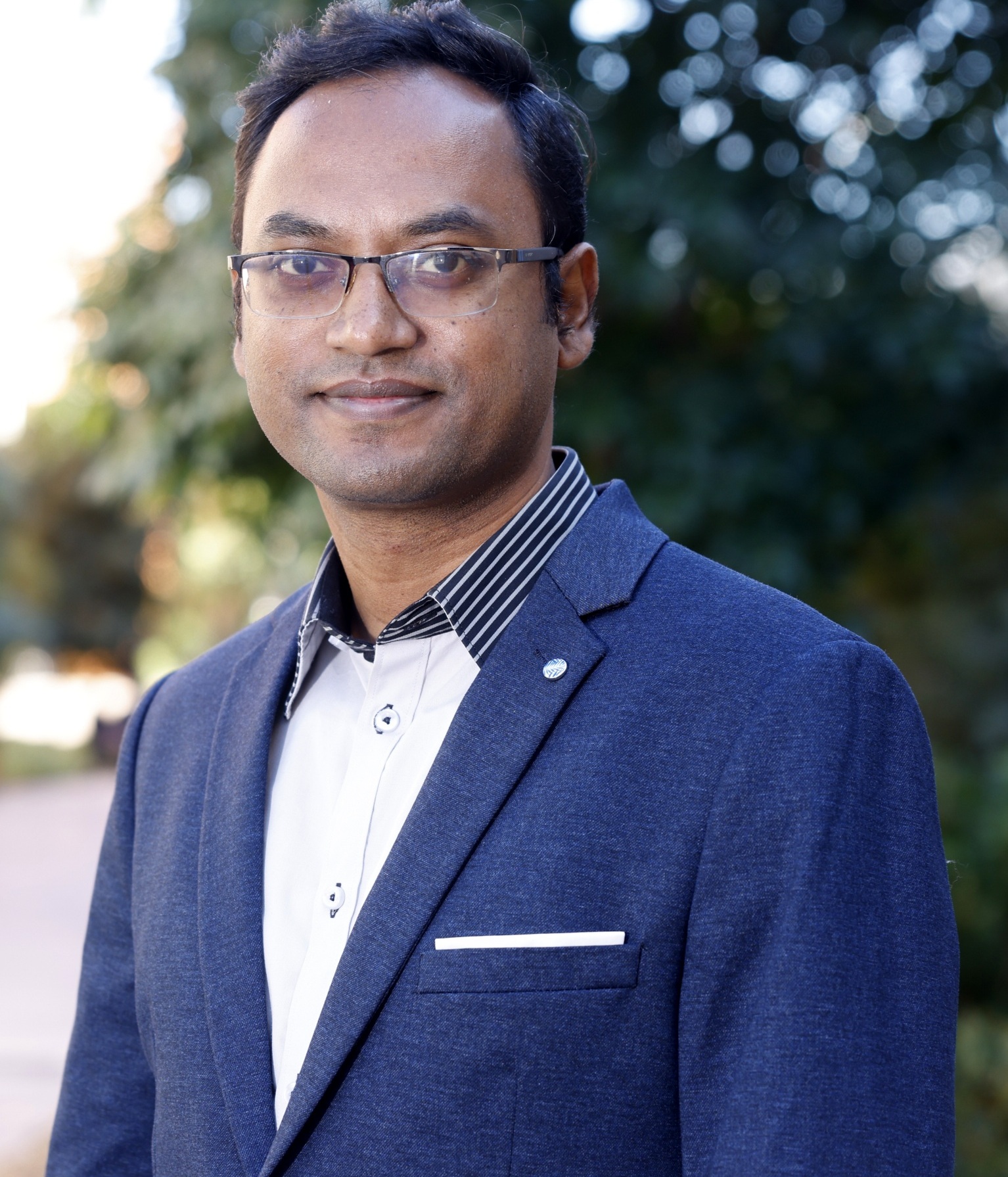
The student will work within the School of Electrical Engineering and Telecommunications at UNSW Sydney under the supervision of Dr Shimul Kanti Nath and Dr Deepak Mishra. Dr Nath’s research focuses on emerging electronic materials and devices, memristors, nonlinear oscillators, optoelectronic devices and neuromorphic hardware. The student will benefit from ongoing research on phase-transition and memristive devices and will have opportunities to use experimentally measured device characteristics to develop realistic computational models of artificial neurons and synapses. Dr Mishra brings complementary expertise in signal processing, machine learning, intelligent sensing and AI-enabled systems. His expertise will support the transition from individual device models toward network-level neuromorphic computation and potential intelligent sensing applications. The project provides an interdisciplinary research environment spanning electronic devices, circuit modelling, artificial intelligence, scientific programming and neuromorphic computing. The student will gain hands-on experience with Python-based modelling and circuit simulation while learning how emerging electronic devices can be used to create brain-inspired computing systems.
- The project will involve modelling and simulation of artificial neurons, artificial synapses and simple neuromorphic networks, with the following expected outcomes:
- Artificial neuron modelling: Develop and simulate neuron models capable of reproducing integration, threshold firing, spiking and/or oscillatory behaviour.
- Artificial synapse modelling: Develop computational models of synaptic behaviour, including tunable synaptic weights, potentiation/depression and basic learning mechanisms.
- Neuromorphic circuit modelling: Integrate artificial neuron and synapse models to construct simple neuromorphic circuits and investigate signal transmission, temporal dynamics and network behaviour.
- Hardware-aware modelling: Where appropriate, incorporate experimentally measured memristive or nonlinear device characteristics to investigate how realistic device behaviour influences neuromorphic computation.
- Application-focused exploration: Explore how the developed models could contribute to energy-efficient edge AI, intelligent sensing and other brain-inspired computing applications.
- Research outcomes: Develop results that may contribute to a future journal or conference publication and provide the student with mentoring and support for future Honours, Masters or PhD research.
- Other outcomes: A poster presentation and a brief presentation or video highlighting the main findings.

- W. Zhang, B. Gao, J. Tang, P. Yao, S. Yu, M. Chang, H.-J. Yoo, H. Qian and H. Wu, ‘Neuro-inspired Computing Chips’, Nature Electronics, 3, 371–382 (2020).
- S. K. Nath, ‘A Light-Driven Device for Neuromorphic Computing’, Light: Science & Applications, 14, 37 (2025).
- S. K. Nath, S. K. Das, S. K. Nandi, C. Xi, C. Marquez, A. Rúa, M. Uenuma, Z. Wang, S. Zhang, R. Zhu, J. Eshraghian, X. Sun, T. Lu, Y. Bian, N. Syed, W. Pan, H. Wang, W. Lei, L. Fu, L. Faraone, Y. Liu and R. G. Elliman, ‘Optically Tunable Electrical Oscillations in Oxide-Based Memristors for Neuromorphic Computing’, Advanced Materials, 2400904 (2024).